
Last updated on October 10th, 2026 at 06:19 am
Last updated on October 10th, 2026 at 06:19 am
If you have seen STFU in a text message, comment, group chat, or social media post, you may have wondered what it means and whether the sender was joking or being rude.
The abbreviation appears often in informal online conversations, especially when people want to react strongly without typing a full sentence.
In most cases, STFU means “shut the f* up.”** It is a blunt and potentially offensive way of telling someone to stop talking.
However, the tone can change depending on the relationship between the people, the platform, and the situation. Close friends may sometimes use it jokingly, while the same phrase from a stranger can sound aggressive or disrespectful.
Understanding the STFU meaning in text is therefore about more than knowing its full form. Context, emojis, punctuation, and the surrounding conversation all help explain what the sender really intended.
STFU Meaning & Definition
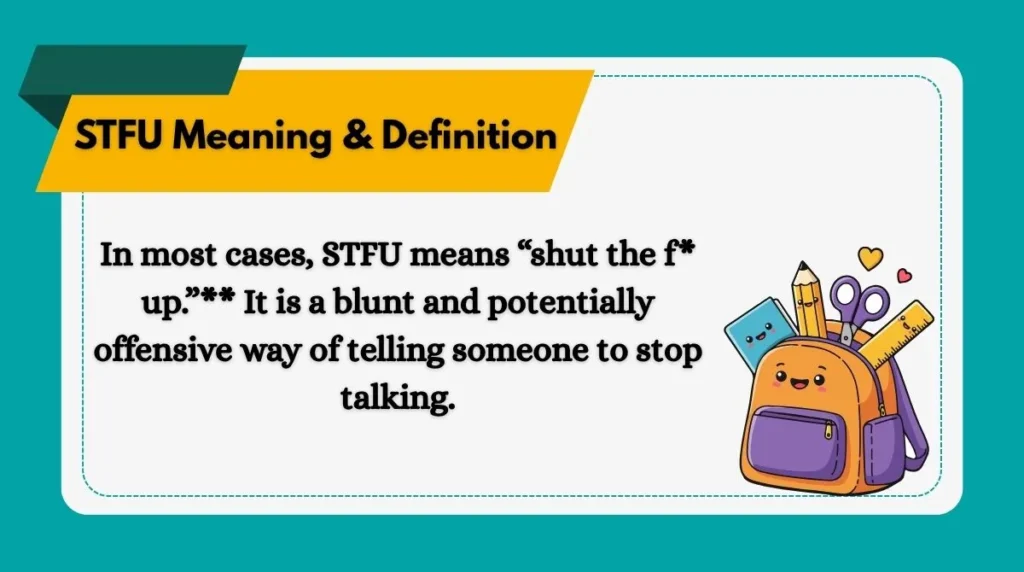
The most common definition of STFU is “shut the f* up.”** It is an internet abbreviation used when someone wants another person to stop talking, stop arguing, or stop saying something surprising.
Because the full phrase contains profanity, STFU is generally considered rude or vulgar. Even though the letters hide part of the wording, most people understand exactly what they represent.
For example:
- “STFU, you actually won?”
- “Bro STFU 😂”
- “STFU and listen for a second.”
- “Can you STFU already?”
These examples may look similar, but their tones can be very different.
“STFU, you actually won? 😂” may express playful disbelief between friends. In contrast, “Can you STFU already?” sounds much more annoyed and confrontational.
The abbreviation can therefore communicate several emotions, including:
- Anger
- Frustration
- Shock
- Playful disbelief
- Excitement
- Sarcasm
The safest interpretation comes from looking at the full conversation. If someone you barely know sends STFU during an argument, it is probably meant negatively. If a close friend uses it alongside laughing emojis after surprising news, it may be playful.
Is STFU Rude or Playful? How to Tell the Difference
STFU can sound rude or playful depending on the situation. Although it stands for “shut the f* up,” people do not always use it as a serious command. The relationship between the sender and receiver often helps explain the intended meaning.
When close friends use STFU with laughing emojis, it may express surprise, excitement, or disbelief.
For example:
- “STFU 😂 You actually won the competition?”
- “STFU, that is the funniest thing I have ever seen.”
- “STFU 😭 I cannot believe you did that!”
In these examples, the abbreviation is more likely to express a strong reaction than genuine anger.
However, STFU can sound offensive when someone uses it during an argument, sends it without a friendly tone, or directs it at someone they barely know.
For example, “STFU and stop arguing with me” sounds aggressive because the sender is directly telling another person to be quiet.
If you are unsure what someone means, consider the conversation before replying. Emojis and friendly language can offer clues, but they do not always guarantee that the message is a joke.
HM Meaning in Text: What Does HM Mean in Chats, Social Media, and Online Conversations?
MYF Meaning in Text: What Does MYF Mean in Texting?
OTW Meaning in Text: What Does OTW Mean in Chats?
Background and Origin of STFU
STFU developed as part of internet shorthand used to make messages faster to type. Abbreviations became especially popular through early online chat rooms, message boards, instant messaging services, and later through texting and social media.
People began shortening common phrases into combinations of letters. Expressions such as LOL, BRB, OMG, IDK, and WTF became normal parts of digital communication. STFU follows the same pattern.
Instead of writing the complete four-word phrase, users type the first letter of each word.
The abbreviation became more visible as online communication moved toward fast, informal platforms. Short messages are especially useful in group chats, gaming conversations, comments, memes, and social media replies.
Today, STFU is widely understood by many internet users. However, it remains much harsher than neutral abbreviations such as LOL or BRB.
Its meaning has also become more flexible. Sometimes people use STFU literally because they want someone to stop speaking. Other times, it simply expresses surprise.
For example:
“STFU! You met my favorite singer?”
Here, the sender may not actually want the other person to be quiet. They are expressing excitement or disbelief.
How STFU Is Used in Different Contexts
The meaning and tone of STFU change significantly depending on where it appears.
In casual chats between close friends, it can sometimes function as exaggerated humor. A friend might say:
“STFU 😂 there is no way you did that.”
The laughing emoji suggests the message is probably playful rather than hostile.
During an argument, however, STFU becomes much more aggressive.
For example:
“STFU. Nobody asked you.”
This message is dismissive and likely intended as an insult.
On social media, users may also use STFU as a reaction to surprising news, celebrity updates, funny videos, or shocking posts.
For example:
“STFU this trailer looks amazing!”
In professional communication, STFU should normally be avoided. It can sound disrespectful, immature, or hostile in emails, workplace chats, customer support conversations, academic messages, and business discussions.
If you need someone to stop interrupting or allow you to finish, safer phrases include:
“Could I finish my point first?”
or:
“Can we keep the conversation respectful?”
These alternatives communicate the same basic need without unnecessary conflict.
STFU Meaning in Chat, WhatsApp, Instagram, and TikTok
On WhatsApp, STFU usually appears in personal conversations or group chats. Friends may use it jokingly, especially when reacting to unexpected news.
Example:
“You got tickets for tonight?”
“Yes.”
“STFU 😭😂”
In this case, the reaction probably means something closer to “No way!” rather than a literal command to stop talking.
On Instagram, STFU may appear in comments, captions, direct messages, memes, or replies. Someone might comment:
“STFU this outfit is perfect.”
The expression acts as an exaggerated reaction.
On TikTok, STFU often appears in comment sections when viewers react to surprising, funny, dramatic, or unbelievable videos.
For example:
“STFU I was not expecting that ending 😭”
Again, it expresses shock rather than anger.
In ordinary chat conversations, punctuation can change the tone too.
“STFU 😂” may feel playful.
“STFU!!!” may feel excited or angry depending on context.
“STFU.” can sound serious, cold, and hostile.
Because text lacks voice and facial expressions, context is essential before deciding how the sender intended the abbreviation.
STFU Meaning in Physics, Medical, and Aircraft Terminology
Unlike many abbreviations, STFU does not have a widely recognized standard meaning in physics, medicine, or aviation that matches its popular texting usage.
In physics, technical abbreviations usually represent scientific quantities, theories, instruments, processes, or organizations. STFU is not generally recognized as a standard physics abbreviation in everyday scientific terminology.
The same applies to medicine. Medical professionals use thousands of abbreviations, but STFU is not commonly accepted as a universal medical abbreviation. If the letters appeared in a hospital document, research paper, or local system, they could potentially represent a specialized internal term. The surrounding document would be necessary to determine the meaning.
In aviation, abbreviations are especially important because communication must remain clear and standardized. STFU should not automatically be interpreted as an official aircraft or aviation abbreviation without reliable context.
Therefore, when you see STFU in casual messages or social media, the slang meaning is far more likely.
When the letters appear inside a professional, scientific, medical, or technical document, avoid assuming they mean the internet expression. Check the source, glossary, organization, or surrounding sentence instead.
Common Misconceptions About STFU
One common misconception is that STFU is always meant as an insult.
It certainly can be insulting, but friends sometimes use it jokingly.
For example:
“STFU, you bought me that?”
Here, the speaker may simply be shocked and happy.
Another misconception is that using an acronym removes the offensive nature of the phrase. It does not. Most readers know what the letters represent, so STFU can still sound vulgar.
Some people also confuse STFU with softer expressions such as “be quiet” or “stop talking.” While their general purpose can overlap, STFU is much stronger.
Another mistake is assuming capitalization changes its meaning.
“stfu” and “STFU” normally mean the same thing. Lowercase letters may sometimes make the message appear slightly more casual, but tone still depends mainly on context.
Finally, people sometimes interpret every technical-looking abbreviation as having one universal definition. STFU is primarily internet slang, and any specialized use outside casual communication should be verified rather than assumed.
Similar Terms and Alternatives to STFU
Several online expressions can communicate emotions similar to STFU without having exactly the same meaning.
Shut up is the closest direct alternative, although it can still sound rude.
OMG means “oh my God” and can express surprise without telling someone to stop talking.
No way is a friendly reaction to unbelievable news.
Seriously? shows disbelief without profanity.
WTF expresses strong confusion or surprise but also contains profanity.
Bro or bruh can communicate disbelief in casual conversations.
For example, instead of:
“STFU you met him?”
someone could write:
“No way! You met him?”
The second version communicates the same surprise with much less risk of sounding aggressive.
Other softer alternatives include:
- You’re kidding!
- Seriously?
- That’s shocking!
- I can’t believe it.
- Wait, what?
- You did not!
- Stop, really? 😂
Choosing an alternative depends on the situation and how well you know the person receiving the message.
How to Respond When Someone Says STFU
Your response should depend on the sender’s tone.
If a friend clearly uses STFU jokingly, you can respond casually.
Example:
“STFU 😂”
Reply:
“HAHA I’m serious!”
If the sender is surprised by your news, you could simply continue explaining what happened.
However, if someone uses STFU aggressively, you do not need to respond with another insult.
You might say:
“There’s no need to speak to me like that.”
or:
“If you want to talk, keep it respectful.”
You can also choose not to respond at all.
When the meaning is unclear, ask directly:
“Are you joking or are you actually mad?”
This can prevent unnecessary misunderstandings.
In professional situations, avoid matching the person’s aggressive language. Keep the response calm and focused on the issue.
For example:
“I’m happy to discuss this, but please keep the conversation professional.”
The best response is usually one that matches the relationship while avoiding an unnecessary argument.
STFU vs Similar Words and Abbreviations
STFU is often grouped with other strong internet abbreviations, but there are important differences.
STFU vs Shut Up:
Both tell someone to stop talking, but STFU contains an added profanity and usually sounds stronger.
STFU vs WTF:
WTF usually expresses confusion, anger, or surprise. It does not directly tell another person to stop speaking.
STFU vs OMG:
OMG expresses surprise and is usually much less aggressive.
STFU vs LOL:
LOL means “laughing out loud” and normally signals humor. STFU can be humorous too, but its literal meaning is much harsher.
STFU vs GTFO:
GTFO usually means “get the f*** out.” It may literally tell someone to leave or may express strong disbelief, such as “GTFO, you actually won!”
Both STFU and GTFO can become playful reactions between friends, but both contain profanity and can easily offend someone when the relationship or context is unclear.
Understanding these differences helps you choose wording that matches the tone you actually want.
STFU in Online Conversations and Dating Apps
On dating apps, STFU should be used carefully.
People who already have a playful relationship may occasionally use it jokingly.
For example:
“You actually remembered my favorite movie?”
“Of course.”
“STFU 😂 that’s cute.”
Here, the message expresses surprised affection rather than hostility.
However, using STFU with someone you have just met can create a negative impression. Without an established relationship, they may interpret the message literally and consider it disrespectful.
Tone is especially difficult to judge on dating apps because people often communicate before meeting face to face.
The same problem exists in online communities, gaming chats, forums, and comment sections. One person may view STFU as harmless humor while another sees it as a direct insult.
Emojis can help indicate tone, but they do not completely remove the risk.
When communicating with strangers, coworkers, new friends, or potential partners, expressions such as “no way,” “you’re joking,” or “seriously?” are usually safer choices.
When Should You Avoid Using STFU?
Although STFU is common in internet slang, it is not suitable for every conversation. Because the phrase contains profanity, it can make a message sound disrespectful even when you do not intend to offend anyone.
Avoid using STFU in professional emails, workplace discussions, school assignments, customer service messages, and conversations with people you do not know well. It may damage relationships or make a simple disagreement worse.
It is also worth avoiding the abbreviation when discussing a serious problem. Someone who is upset may interpret it as an insult rather than a joke.
Instead of writing “STFU,” you can use softer expressions that communicate your meaning more clearly.
For example:
- “Could you please let me finish?”
- “Let’s talk about this calmly.”
- “Please give me a moment to explain.”
- “No way! Is that really true?”
- “You’re kidding, right?”
These alternatives help you express frustration, surprise, or disagreement without using unnecessarily harsh language.
Before sending a message, think about who will read it and how they might interpret it. A phrase that feels funny between close friends may sound rude to someone else.
Frequently Asked Questions
What does STFU mean in text messages?
STFU stands for “shut the f* up.” It is an informal abbreviation used to tell someone to stop talking or to express strong surprise, disbelief, or frustration.
Is STFU a bad word?
Yes, STFU is considered vulgar internet slang because its full form contains profanity. It may be used jokingly among friends, but it can offend people in other situations.
What does STFU mean from a girl?
When a girl texts STFU, the meaning depends on the conversation. She might be joking, expressing surprise, reacting to exciting news, or telling someone to stop talking.
What does STFU mean from a guy?
When a guy sends STFU, he may be joking with a friend, showing disbelief, expressing frustration, or being rude. The surrounding messages and relationship help determine his intention.
What does STFU mean with a laughing emoji?
STFU with 😂 often expresses playful disbelief or amusement. For example, “STFU 😂 You really did that?” may mean the sender is surprised and finds the situation funny.
Is STFU the same as shut up?
They have a similar basic meaning, but STFU is generally harsher because its full form includes profanity. “Shut up” can also sound rude, depending on the tone and situation.
What can I say instead of STFU?
You can say “No way,” “Seriously?”, “You’re kidding,” or “I can’t believe it” when expressing surprise. If you want someone to stop talking, try “Could you please let me finish?” for a more respectful approach.
Conclusion
Understanding the STFU meaning in text is simple at first but more complicated when tone enters the conversation. The abbreviation most commonly stands for “shut the f* up,”** making it a strong and potentially offensive expression.
However, online slang does not always follow its literal definition. Close friends may use STFU to express laughter, excitement, disbelief, or surprise.
Messages such as “STFU 😂 you actually did that?” usually sound very different from an angry “STFU.”
The platform, relationship, punctuation, emojis, and surrounding conversation all help reveal the intended meaning.
STFU is mainly associated with informal texting and internet slang rather than standard scientific, medical, or aviation terminology. It should also generally be avoided in professional communication.
When you are unsure about the tone, consider the context before reacting. And when writing your own message, remember that softer alternatives such as “no way,” “seriously?” or “you’re kidding” can communicate surprise without sounding unnecessarily aggressive.
RQ Meaning in Text: What Does RQ Mean in Texting?
WSG Meaning in Text: What Does WSG Mean in Chats and Social Media?
TB Meaning in Text: What Does TB Mean in Texting?



5 thoughts on “STFU Meaning in Text What It Means in Chats, Social Media, and Online Conversations Updated 2K26”