Have you ever met someone who uses complicated words to make a simple point, or seen a social media post that seems more interested in looking impressive than sharing something real? The word pretentious is often used to describe this kind of behavior.
It can apply to people, conversations, art, restaurants, writing, and even the way someone presents their life online.
People search for the pretentious definition because the word can be confusing. It is often mistaken for being confident, wealthy, educated, or simply having expensive taste.
However, pretentiousness is more about the impression someone tries to create than the things they genuinely enjoy or know.
This guide explains the meaning of pretentious in clear English, its background, common examples, and how it differs from related words.
You will also learn how to recognize it in everyday conversations, social media, professional settings, and dating apps, along with practical ways to respond without being rude.
Meaning & Definition
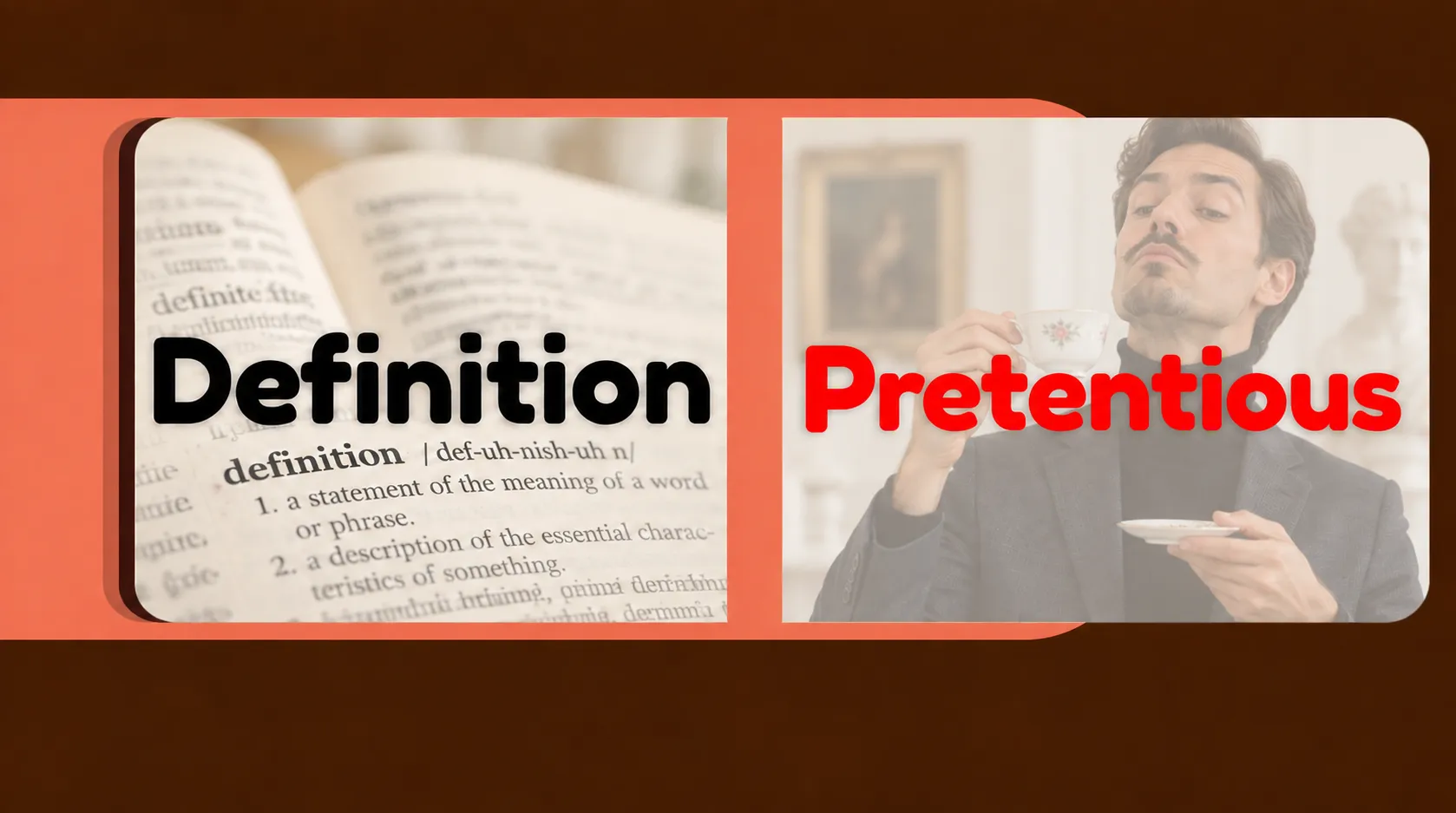
Pretentious is an adjective used to describe someone or something that tries to appear more important, sophisticated, intelligent, cultured, or impressive than they really are. The word usually suggests that the appearance is exaggerated, artificial, or intended to gain admiration.
In simple terms, a pretentious person may act as though they are special or superior in order to impress others. The key idea is not merely having knowledge or good taste, but making an unnecessary show of it.
For example, imagine a person who enjoys classical music and talks about it naturally. That person is not necessarily pretentious. However, someone who claims that all other music is worthless and uses obscure terms only to make others feel less knowledgeable may be described as pretentious.
The word can also describe things rather than people. A restaurant with an overly elaborate menu that makes ordinary dishes sound impossibly grand might be called pretentious. A film, book, or speech may receive the same description if it seems to prioritize appearing profound over communicating something meaningful.
Pretentious is generally a negative or critical word. It expresses an opinion about how something comes across, not an objective fact about a person’s character. Because of this, it should be used thoughtfully, especially when describing someone directly.
Background of the Word Pretentious
The word pretentious is connected to pretension, which refers to a claim or an attempt to appear entitled to a certain status, quality, or level of importance. Its roots can be traced through French to the Latin verb praetendere, meaning to stretch forth, put forward, or claim.
Over time, the word developed its modern sense of making an excessive or unjustified display of importance. In English, pretentious became a useful way to describe the gap between what someone presents and what others believe is genuine.
The idea itself is much older than modern slang. Throughout history, people have criticized those who exaggerate their status, use grand language, or imitate elite customs to gain social approval. Literature and comedy often use pretentious characters to highlight the difference between appearance and reality.
Today, the word is common in reviews of art, food, fashion, and entertainment. It also appears frequently in ordinary conversation. A person might describe an unnecessarily complicated presentation as pretentious or use the word to criticize a celebrity interview that seems overly self-important.
Although the word has historical roots, its meaning has remained fairly consistent: it points to an impression of exaggerated sophistication or importance rather than genuine substance.
Usage in Different Contexts: Chat, Social Media, and Professional Fields
Pretentious can be used in many situations, but its meaning depends on what is being criticized. In casual chat, it often describes a person’s attitude. For instance, someone might say, “He sounds pretentious when he talks about his expensive holidays,” meaning that he appears to be showing off rather than sharing his experiences.
On social media, the word may describe captions, videos, or lifestyle content that seem carefully designed to project superiority. A post full of unnecessarily complex language or exaggerated claims about personal success might be called pretentious. However, sharing achievements or enjoying luxury does not automatically make someone pretentious.
In professional settings, the term can describe communication that is more elaborate than necessary. A report filled with impressive-sounding jargon but little useful information may come across as pretentious. Similarly, a speaker who uses technical terms to avoid giving a clear answer may create that impression.
In art and entertainment, critics sometimes use pretentious to describe work that appears to aim for depth or sophistication without achieving it. Such judgments are subjective: one viewer may find a film meaningful while another considers it pretentious.
Across these contexts, the common thread is an exaggerated presentation of importance. The word is most useful when the specific behavior is explained rather than used as a vague insult.
Pretentious Meaning in Chat, WhatsApp, Instagram, and TikTok
In digital conversations, pretentious keeps its ordinary English meaning. It is not a special abbreviation or platform-specific slang term. People use it to describe someone who seems to be trying too hard to look impressive, intellectual, or superior.
On WhatsApp or in a group chat, a friend might write, “That message was a bit pretentious,” after someone turns a simple discussion into a long display of complicated vocabulary. The comment usually criticizes the tone rather than the person’s actual intelligence.
On Instagram, the word may appear in comments about captions, fashion, travel, or lifestyle content. A user might call a caption pretentious if it turns a simple coffee photo into an elaborate statement about personal enlightenment. This does not mean that artistic captions or thoughtful writing are automatically pretentious.
On TikTok, the term is often used in reactions, reviews, and discussions about influencers, films, music, or trends. Someone might describe a creator’s speech as pretentious if it seems designed to sound profound without communicating much.
The tone can range from playful teasing to genuine criticism. If a close friend says, “You’re being pretentious,” they may be joking. If a stranger uses it in a heated comment, it is more likely intended as an insult. Context, relationship, and delivery matter.
Meaning in Physics, Medical, and Aircraft Terminology
Pretentious is not a standard technical term with a special definition in physics, medicine, or aircraft terminology. In these fields, it retains its ordinary meaning when used as an adjective, usually to criticize the style of communication or presentation.
In physics, someone might describe an explanation as pretentious if it uses advanced terminology unnecessarily to make a simple concept seem more impressive. This is a judgment about the explanation, not a scientific classification. The word should not be confused with technical terms such as pretension or pre-tension, which can refer to an initial tension or force applied to a component.
In medicine, a patient or colleague might call a statement pretentious if it sounds overly grand or self-important. However, pretentious is not a medical diagnosis, symptom, or recognized clinical condition. It should not be used to label someone with a psychological disorder.
In aviation, the word may describe the tone of a speech, advertisement, or conversation, but it has no established aircraft-specific meaning. Aviation uses precise technical vocabulary, and pretentious is not a substitute for those terms.
The distinction is important: an unfamiliar word in a technical document should be interpreted according to its actual context. Do not assume that pretentious has a specialized meaning simply because it appears alongside scientific, medical, or aviation language.
Common Misconceptions About Pretentious
One common misconception is that pretentious means rich. Wealth and pretentiousness are not the same thing. A wealthy person can be modest, while someone with very little money can still act pretentiously. The word describes a perceived attitude or presentation, not financial status.
Another mistake is assuming that educated people are pretentious. Knowledge, intelligence, and advanced vocabulary are not inherently pretentious. A scientist explaining a complex topic may need technical language. The issue arises when complexity is used unnecessarily to impress or exclude others.
Pretentious is also sometimes confused with confidence. A confident person believes in their abilities, while a pretentious person may exaggerate their importance or sophistication. Confidence can be genuine and grounded; pretentiousness suggests an artificial display.
Having unusual taste is not enough to make someone pretentious either. Enjoying experimental films, rare books, fine dining, or unconventional fashion is simply a matter of preference. It becomes reasonable to use the word only when the person seems to use those interests to claim superiority.
Finally, pretentious does not always mean fake. Someone may genuinely believe in their own importance while still appearing pretentious to others. The word describes an impression of excessive display, so it should not be treated as proof that someone is lying or intentionally deceiving people.
Similar Terms & Alternatives
Several words are related to pretentious, but each carries a slightly different meaning. Choosing the right alternative can make your description more accurate and less unnecessarily harsh.
Showy describes behavior or appearance intended to attract attention. A showy person may display expensive possessions or dramatic clothing, but the emphasis is on visibility rather than intellectual or cultural superiority.
Pompous refers to someone who acts excessively important or speaks in a grand, self-serious manner. It is often used for people who treat ordinary matters as though they deserve great ceremony.
Affected describes behavior, speech, or manners that seem unnatural or deliberately adopted to create an impression. It is especially useful when someone appears to be performing a personality or style that does not feel genuine.
Ostentatious usually refers to a conspicuous display of wealth, status, or possessions. A luxury car covered in attention-grabbing details might be described as ostentatious without necessarily being pretentious.
Self-important focuses on an exaggerated belief in one’s own significance. Snobbish describes someone who looks down on others because of perceived differences in class, taste, education, or status.
More neutral alternatives include overly elaborate, formal, complicated, or trying too hard. These can be useful when you want to criticize a specific style without making a strong judgment about the person.
How to Respond to Someone Being Pretentious
The best response depends on the situation and your relationship with the person. In many cases, it is more effective to address the behavior than to call someone pretentious directly. A personal label can make the conversation defensive, while a specific request may lead to better communication.
If someone uses unnecessarily complicated language, you can ask, “Could you explain that in simpler terms?” This keeps the focus on understanding rather than challenging their intelligence. In a professional meeting, you might say, “What is the main point we should take away from this?” Such questions encourage clarity without creating conflict.
If a friend is showing off, gentle humor may work. A light comment such as, “That was quite the grand introduction,” can signal that their tone feels excessive. However, humor should not be used to embarrass someone in front of others.
When the behavior is harmless, you may choose not to respond at all. People sometimes communicate awkwardly because they are nervous, excited, or trying to fit in. What appears pretentious may not be intentional.
If someone calls you pretentious, consider asking what specifically gave that impression. You do not need to accept every criticism, but understanding the behavior behind the label can help you decide whether to adjust your tone or explain your intentions.
Differences Between Pretentious and Similar Words
Pretentious is often grouped with arrogant, snobbish, pompous, and sophisticated, but these words are not interchangeable. Understanding their differences helps prevent unfair descriptions.
An arrogant person has an exaggerated sense of their own abilities or importance and may treat others as inferior. A pretentious person, by contrast, is specifically concerned with appearing impressive or sophisticated. Someone can be both, but one quality does not automatically imply the other.
A snobbish person judges others according to social status, education, wealth, or taste. Pretentiousness may involve pretending to possess those qualities or displaying them excessively. Snobbery focuses more on looking down on others, while pretentiousness focuses on the impression being created.
Pompous is close in meaning but often suggests grand speech, ceremony, and self-importance. Pretentious is broader and can describe an outfit, restaurant, book, or social media profile as well as a person’s manner.
Sophisticated is usually a positive or neutral word. It can describe genuine knowledge, refined taste, or complexity. Pretentious implies that sophistication is exaggerated or presented in a way that feels artificial.
A useful distinction is that sophistication is about the quality itself, while pretentiousness is about the perceived attempt to display that quality for admiration.
Relevance in Online Conversations & Dating Apps
Pretentious is especially relevant online because digital profiles give people many opportunities to shape how others see them. Carefully chosen photos, captions, job titles, and personal descriptions can create an image that is more polished than everyday life.
On dating apps, someone may be described as pretentious if their profile seems designed to establish superiority. For example, a bio that dismisses ordinary interests or insists that only highly cultured people are worth meeting may give that impression. However, listing achievements, education, or personal preferences is not automatically pretentious.
The word also appears in discussions about dating behavior. A person who constantly corrects a date’s vocabulary, name-drops influential contacts, or treats simple activities as beneath them may be perceived as pretentious. The issue is the way they relate to others, not whether they actually possess knowledge or success.
Online conversations can make these judgments less reliable because tone is difficult to interpret. A short message may seem cold, and a detailed message may seem overly formal, even when neither was intended that way.
If you encounter behavior that feels pretentious, look for a pattern rather than judging a single sentence. Genuine curiosity, respect, and the ability to communicate naturally are more useful indicators of compatibility than one impressive-sounding profile or unusual interest.
Conclusion
The pretentious definition centers on an exaggerated attempt to appear important, sophisticated, intelligent, or impressive. It is a critical word used to describe the gap between a person’s presentation and the impression of genuine substance.
It can apply to people, writing, art, social media content, and many other situations.
Understanding the word also means knowing what it does not imply. Being wealthy, educated, confident, or interested in unusual subjects is not inherently pretentious.
The important factor is whether someone appears to be making an unnecessary display of superiority or sophistication.
Because pretentious is subjective, it is best used with care. Explain the specific behavior you mean, especially in personal or professional conversations.
When responding to someone who seems pretentious, a request for clarity or a polite change of subject is often more productive than an insult.
With these distinctions in mind, you can recognize the word, use it accurately, and understand what others mean when it appears in everyday speech or online conversations.