The word rebuke may sound formal, but it describes something most people experience at some point: being told firmly that their behavior is wrong.
You might hear it in a classroom, read it in a news report, or see it in a message after someone has crossed a line. Understanding the rebuke definition helps you recognize when a person is expressing serious disapproval rather than offering a casual suggestion.
People often search for this word because it appears in books, professional conversations, religious writing, and online discussions.
They may also want to know whether a rebuke is the same as criticism, a reprimand, or an insult. Although these words overlap, they do not always carry the same meaning.
This guide explains the meaning, background, pronunciation, and everyday use of rebuke. It also explores how the word appears in digital conversations, specialized fields, and relationships, with clear examples to help you use it naturally and confidently.
Meaning & Definition
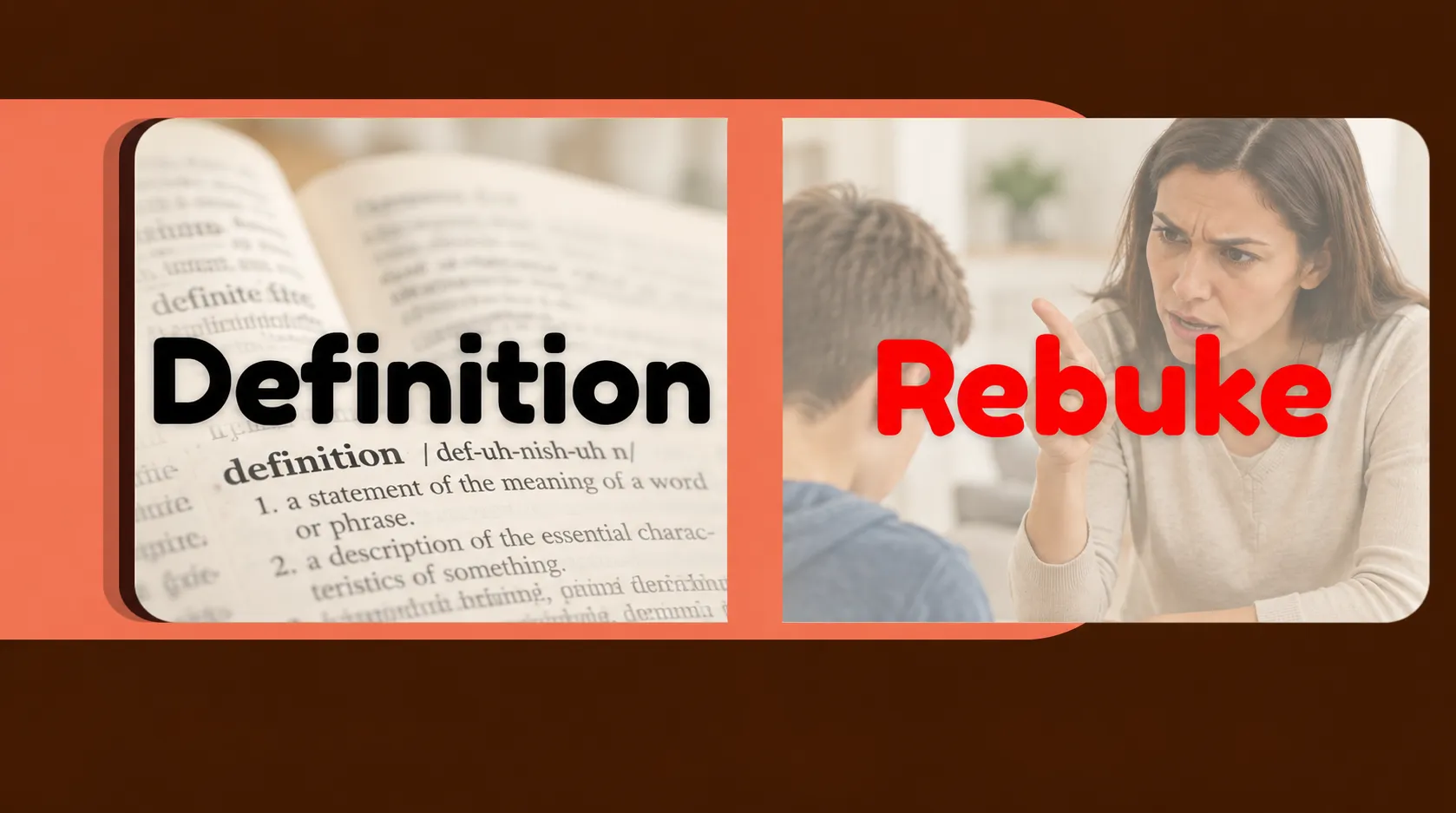
Rebuke means to express strong disapproval of someone’s actions, words, or behavior. It is usually a firm correction or criticism intended to show that something was unacceptable. The word can function as both a verb and a noun.
As a verb, to rebuke someone is to tell them sharply that they have done something wrong. As a noun, a rebuke is the statement or action that expresses that disapproval.
For example, a teacher may rebuke a student for bullying a classmate. A manager may rebuke an employee for repeatedly ignoring safety rules. A friend may rebuke another friend for making a hurtful comment.
The word is pronounced rih-BYOOK, with the stress on the second syllable. Its past tense is rebuked, and the present participle is rebuking.
A rebuke is generally stronger than a mild correction. Saying “Please check your work again” is usually a suggestion, while saying “Your careless behavior has put others at risk” may be a rebuke. However, a rebuke does not have to involve shouting or cruelty. A person can express serious disapproval in a calm, controlled voice.
The key idea is that someone is being called to account for behavior considered wrong, inappropriate, or unacceptable.
Background
The word rebuke has a long history in the English language. It entered Middle English through Old French, with earlier forms associated with the idea of pushing back or expressing opposition. Over time, its meaning developed into the sense of sharply correcting or expressing disapproval of a person’s conduct.
Historically, rebuke has appeared in religious, legal, literary, and everyday writing. In religious contexts, it often refers to correcting wrongdoing or warning someone against harmful behavior. In older literature, a character might receive a rebuke from a parent, ruler, or respected authority. These uses helped establish the word’s serious and somewhat formal tone.
Today, rebuke remains common in journalism and public statements. A headline might describe a public official rebuking another official, meaning that one has openly criticized the other’s conduct or decision. The word is also used in personal situations, although people may prefer simpler alternatives such as “scold,” “criticize,” or “tell off.”
Its meaning has remained fairly consistent across centuries. What changes is the setting, the level of formality, and the relationship between the people involved. A rebuke can come from an authority figure, but it can also come from an equal who believes a boundary has been crossed.
Usage in Different Contexts (Chat, Social Media, Professional Fields)
Rebuke is useful in many settings because it describes the seriousness of a correction rather than one specific type of punishment.
Everyday conversation: A parent might rebuke a child for speaking disrespectfully, or a friend might rebuke someone for breaking a promise. The word suggests that the speaker is not merely pointing out a small mistake but expressing clear disapproval.
Workplace situations: A supervisor may rebuke an employee for misconduct, missed responsibilities, or disregard for company procedures. In professional writing, however, a rebuke should not automatically be confused with a formal disciplinary action. An official warning, reprimand, or other procedure depends on the organization’s rules.
News and public discussion: Journalists often use rebuke to describe strong public criticism. For example, “The committee rebuked the decision” means the committee expressed serious disapproval of it. The criticism may be directed at a person, policy, action, or statement.
Social media: A creator may rebuke offensive comments, or a community may rebuke someone for spreading misinformation. The word often appears when the criticism is direct and forceful.
In each context, the central meaning stays the same: a clear expression that something is wrong and should not be accepted.
Rebuke Meaning in Chat, WhatsApp, Instagram, and TikTok
In digital communication, rebuke is not a special acronym or a platform-specific slang term. It keeps its ordinary English meaning: to criticize or correct someone firmly.
On WhatsApp, someone might write, “My boss rebuked me for sending the wrong file.” This means the boss expressed strong disapproval, not simply that the file was incorrect. In a group chat, a person may say, “I had to rebuke him for insulting everyone,” meaning they confronted the behavior.
On Instagram, the word may appear in captions, comments, or discussions about public behavior. For example, “The artist rebuked the hateful comments” means the artist openly rejected or criticized them.
On TikTok, users may describe a creator rebuking a dangerous trend or responding firmly to an offensive statement. The word is sometimes used dramatically for humor, but its basic meaning does not change.
The tone of a digital rebuke can be difficult to judge because written messages lack facial expressions and vocal cues. A sentence that seems harsh may have been intended as a serious but respectful correction. Context, punctuation, and the relationship between the people involved are important when interpreting it.
Meaning in Physics, Medical, and Aircraft Terminology
Rebuke is an ordinary English word rather than a recognized standard technical term in physics, medicine, or aviation. It is important not to invent specialized definitions simply because the word appears near scientific or professional language.
Physics: Rebuke does not describe a physical quantity, scientific law, equation, or established process. A physics professor might rebuke a student for unsafe laboratory conduct, but the word would refer to the professor’s criticism, not to a physics concept.
Medical settings: A doctor, nurse, or administrator might rebuke a colleague for violating a safety procedure. In that situation, the word retains its normal meaning of strong disapproval. It is not a diagnosis, treatment, medical abbreviation, or clinical measurement.
Aircraft and aviation: A pilot, instructor, or aviation authority may rebuke unsafe behavior or a failure to follow procedures. Again, the word describes a human response. It is not a standard aircraft component, flight maneuver, or aviation acronym.
In specialized fields, always distinguish ordinary vocabulary from official terminology. If a document uses rebuke, read the surrounding sentence to determine who is criticizing whom and why. Do not assume the word has a hidden technical meaning.
Common Misconceptions
One common misconception is that rebuke always means shouting. A rebuke can be delivered loudly, but it can also be quiet, formal, or written. A carefully worded statement of serious disapproval may still qualify as a rebuke.
Another misunderstanding is that rebuke is identical to punishment. Rebuking someone means expressing disapproval; punishment involves imposing a consequence. A person may receive a rebuke without receiving any formal penalty.
Some people also assume that only authority figures can rebuke others. While the word is frequently associated with teachers, managers, parents, and leaders, anyone can rebuke behavior they consider unacceptable. A friend can rebuke another friend, and a member of the public can rebuke a public figure.
Rebuke should not automatically be interpreted as an insult. An insult attacks or belittles a person, while a constructive rebuke focuses on behavior and accountability. Nevertheless, a rebuke can become insulting if it is delivered in a humiliating or abusive manner.
Finally, the word is not necessarily negative in every moral sense. A justified rebuke can help prevent harm or encourage responsibility. Whether it is fair depends on the facts, the tone, and the circumstances.
Similar Terms & Alternatives
Several words can replace rebuke, but each has a slightly different emphasis. Choosing the right alternative depends on how strong the criticism is and whether it is formal or informal.
- Scold: To criticize someone angrily, often for a mistake or bad behavior.
- Reprimand: To express official or serious disapproval, especially in a workplace or institution.
- Criticize: To point out faults or express a negative judgment; it may be mild or strong.
- Admonish: To warn or correct someone firmly, often with the intention of improving their behavior.
- Chastise: To criticize severely or punish someone for wrongdoing.
- Tell off: An informal expression meaning to speak angrily to someone about their behavior.
- Censure: To express strong, often formal, disapproval of conduct.
- Correct: To identify and address an error, usually with a less severe tone.
For example, a teacher may correct a wrong answer, admonish a student who is becoming disruptive, and rebuke a student who deliberately harms another person.
The best synonym is not always the strongest one. If the situation involves only a small mistake, words such as “correct” or “advise” may be more accurate than rebuke.
How to Respond to a Rebuke
Receiving a rebuke can feel uncomfortable, especially when it happens in public or arrives through a written message. The most useful response depends on whether the criticism is fair, how it is delivered, and what needs to happen next.
If the rebuke is justified, acknowledge the specific behavior rather than becoming defensive. For example, you might say, “I understand why that was inappropriate. I’ll make sure it does not happen again.” A sincere response shows that you have understood the concern.
If the criticism is unclear, ask for details. You could say, “Can you explain which part of my actions caused the problem?” This helps separate the actual issue from assumptions or misunderstandings.
When you disagree, respond calmly and explain your perspective. A respectful reply might be, “I understand your concern, but I see the situation differently. May I explain what happened?” Disagreement does not require hostility.
If the rebuke is insulting, threatening, or repeatedly humiliating, it is reasonable to set boundaries or seek appropriate support. A firm correction should not be used as an excuse for abusive behavior.
In online conversations, avoid replying instantly when emotions are high. Read the message carefully, consider the context, and choose a response that addresses the issue without unnecessarily escalating it.
Differences From Similar Words
The main difference between rebuke and related words is the degree, purpose, and formality of the disapproval.
Rebuke vs. criticize: Criticism is a broad term that can apply to ideas, performance, decisions, or behavior. A rebuke is usually more direct and serious, often involving conduct considered wrong.
Rebuke vs. reprimand: A reprimand is commonly associated with an official or disciplinary setting. Rebuke can be formal, but it does not necessarily carry an institutional meaning.
Rebuke vs. scold: Scolding often suggests an angry or emotional correction, especially by a parent or teacher. Rebuke is more formal and may be delivered without anger.
Rebuke vs. admonish: Admonish often emphasizes warning or advising someone to change. Rebuke places stronger emphasis on expressing disapproval of what has already happened.
Rebuke vs. insult: An insult is intended to offend or demean. A rebuke may be unpleasant to receive, but its purpose can be to identify wrongdoing and encourage correction.
For instance, “Your report needs more evidence” is criticism. “You knowingly submitted false information, and that is unacceptable” is a rebuke. The second statement carries a stronger judgment about the person’s conduct.
Relevance in Online Conversations & Dating Apps
In online conversations and dating apps, rebuke is less common than informal phrases such as “call out,” “tell off,” or “set someone straight.” Nevertheless, it can appear when people discuss boundaries, disrespect, or inappropriate messages.
For example, someone may say, “I rebuked him for making that rude comment.” This means they firmly expressed disapproval. Another person might write, “She rebuked my joke,” suggesting that the joke was considered offensive or unacceptable.
In dating contexts, the difference between a respectful rebuke and an unhealthy interaction matters. A person may appropriately object to a disrespectful comment, repeated pressure, or a violation of boundaries. However, constant criticism, humiliation, or attempts to control someone should not be excused merely as “rebuking.”
The word can also appear in profiles or discussions about communication styles. Someone who says they “do not respond well to rebukes” may mean they dislike being addressed harshly. The exact intention should be understood from the surrounding conversation rather than assumed.
When using the word online, remember that it sounds more formal than everyday slang. In casual messages, “I called him out” may sound more natural, while rebuke is useful when you want to emphasize serious disapproval.
Conclusion
The rebuke definition centers on one clear idea: expressing strong disapproval of someone’s behavior, words, or actions. It can be used as a noun or a verb and appears in everyday speech, literature, news, workplaces, and online conversations.
Although the word often sounds formal, its meaning is straightforward.
A rebuke is stronger than a mild suggestion, but it does not automatically involve shouting, punishment, or cruelty. It may be constructive when it addresses genuine wrongdoing, or harmful when it becomes unfair or humiliating.
Understanding this distinction helps you interpret the word accurately and respond appropriately.
When choosing between rebuke, criticize, reprimand, scold, and admonish, consider the seriousness and purpose of the message.
In digital conversations, context is especially important because tone can be misunderstood. With these meanings and examples in mind, you can recognize rebuke in different settings and use it confidently in your own writing and conversations.