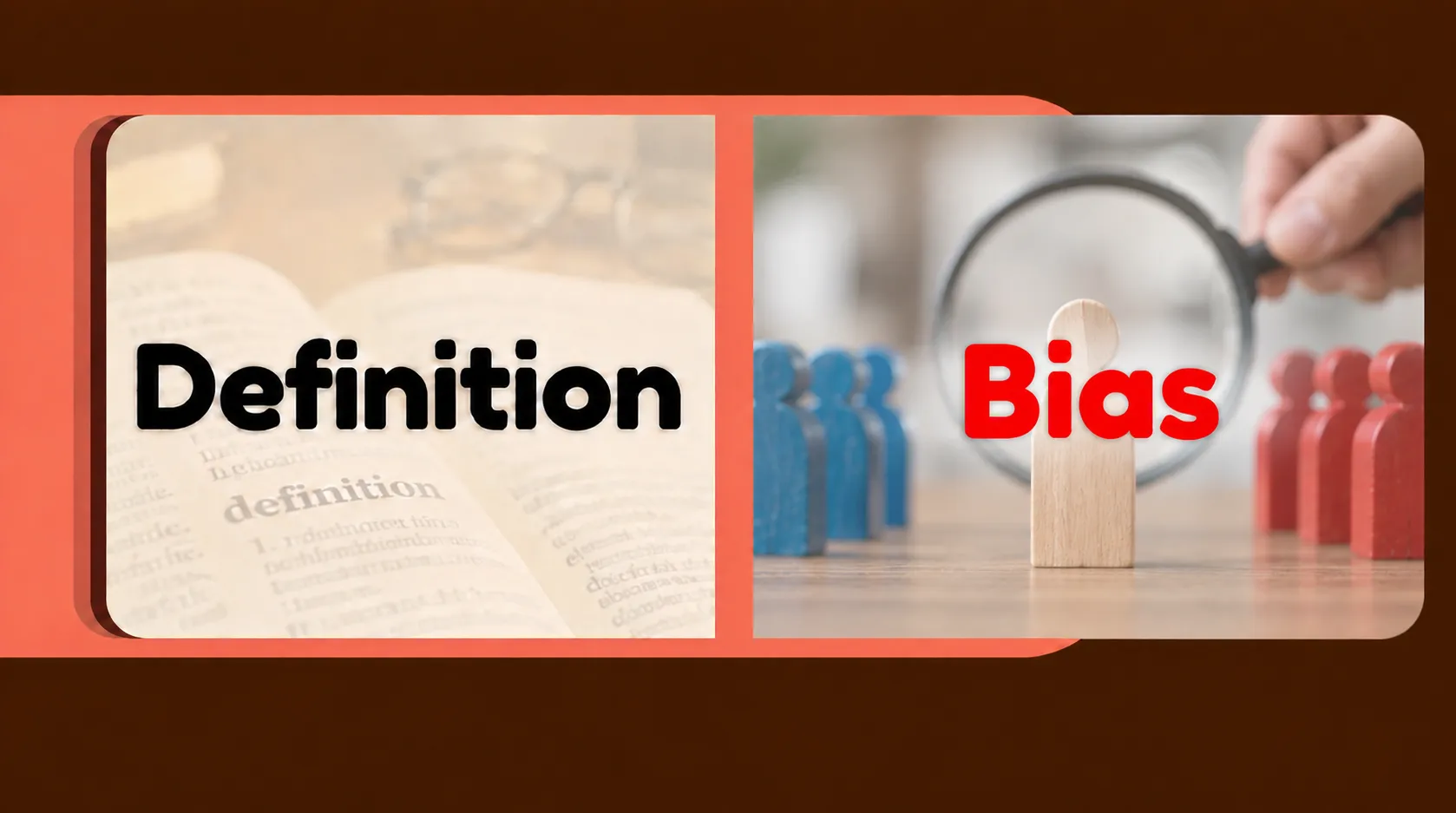
Bias is a tendency to favor, prefer, judge, or lean toward one person, idea, group, or outcome over another. It can be conscious, where someone knows they have a preference, or unconscious, where a person may not realize that their past experiences are affecting their judgment.
People often search for the bias definition because the word appears in many different situations. You may hear it in news reports, social media debates, workplaces, schools, relationships, scientific research, healthcare, or everyday conversations.
Although the basic idea remains similar, its exact meaning can change depending on the context.
Understanding bias is useful because it helps people recognize how opinions and decisions are formed. Not every preference is automatically harmful, but bias can become a problem when it prevents fair thinking or causes someone to ignore important facts.
This guide explains the meaning of bias, its background, examples, related terms, technical uses, and how to respond when bias affects a conversation or decision.
Meaning & Definition
What Does Bias Mean?
Bias means having a preference, tendency, or judgment that favors one side over another. It often influences the way someone understands information, evaluates people, or makes decisions.
A simple example is a sports fan believing their favorite team is always better than its rivals. Their opinion may be influenced by personal loyalty rather than a completely neutral comparison.
Bias can appear in many forms. Someone may have a positive bias toward something they already like or a negative bias against something based on past experiences.
Conscious and Unconscious Bias
A conscious bias happens when a person knows about their preference.
For example, someone might openly admit:
“I prefer working with experienced employees because I trust them more.”
An unconscious bias operates without deliberate awareness. A person may believe they are being completely fair while still being influenced by habits, assumptions, stereotypes, or previous experiences.
Bias is therefore not always intentional. It can develop naturally as the brain tries to process large amounts of information quickly.
Recognizing bias does not always mean accusing someone of dishonesty. Instead, it can mean noticing that a particular preference or assumption may be affecting judgment.
Background
Where Does the Word Bias Come From?
The word bias has been used for centuries. Its older meanings were connected with a slant, curve, or tendency toward one direction. Over time, the word developed a broader meaning related to opinions and judgments that lean toward one side.
That idea of “leaning” still helps explain the modern definition.
A balanced judgment considers different possibilities fairly. A biased judgment leans more strongly toward one conclusion, person, or viewpoint.
Why Humans Develop Bias
People naturally organize information into categories. This helps the brain make quick decisions without carefully studying every detail of every situation.
Past experiences can strongly influence this process.
For example, if someone has several unpleasant experiences with a particular service, they may expect the service to be bad in the future. Their expectations can influence how they interpret new experiences.
Culture, family, education, friendships, media, personal experiences, and social environments can also influence assumptions.
Bias therefore develops through many different paths. Some biases are personal, while others may be shared across communities or professional environments.
The important point is that having a bias does not automatically mean someone is intentionally unfair. However, recognizing possible bias can help people make more thoughtful decisions.
Usage in Different Contexts
Bias in Everyday Conversation
In normal conversation, bias usually means that someone is not completely neutral.
For example:
“You are biased because she is your best friend.”
The speaker means that friendship may be affecting the person’s judgment.
Someone might also say:
“That review seems biased.”
Here, they are suggesting that the review strongly favors or criticizes something instead of giving a balanced evaluation.
Bias in Social Media
Bias is frequently discussed on social platforms when people debate news, celebrities, brands, sports teams, relationships, or public issues.
Users may accuse an account of showing bias when they believe it consistently presents one side more positively than another.
However, disagreement alone does not prove bias. Two people can examine the same situation and reach different conclusions without either person deliberately ignoring facts.
Bias in Professional Fields
In workplaces, bias may affect hiring, promotions, evaluations, teamwork, or decision-making.
In research, scientists try to reduce bias because personal expectations or poor study methods can influence results.
In journalism, the term may refer to choices about which stories, facts, voices, or perspectives receive attention.
In statistics, bias can describe a systematic error that causes estimates or measurements to consistently move away from an accurate value.
Meaning in Chat, WhatsApp, Instagram, and TikTok
Bias Meaning in Text Messages
In text conversations, biased usually means someone believes another person is unfairly supporting one side.
For example:
Person A: “Mia definitely has the best style.”
Person B: “You are biased 😂 She is your sister.”
Here, the second person jokingly suggests that the family relationship is influencing the opinion.
Bias on WhatsApp and Instagram
On WhatsApp, friends may use the word during debates about relationships, sports, entertainment, or personal decisions.
Someone might write:
“Ask someone else. I am biased because I already like him.”
On Instagram, the term often appears in comments about creators, products, celebrities, fashion, sports, or reviews.
A follower might say that a review looks biased if they believe the reviewer has a strong connection with the product or brand.
Bias on TikTok
TikTok discussions often use words such as biased, unbiased, and bias when creators compare products, trends, people, or opinions.
For example:
“I might be biased, but this is still my favorite version.”
In this situation, the creator openly admits having a personal preference.
The phrase “I may be biased” is commonly used online as a friendly way of acknowledging that personal feelings could influence an opinion.
Meaning in Physics, Medical, and Aircraft Terminology
Bias in Physics and Measurement
In physics and scientific measurement, bias can describe a consistent shift or systematic error in a measurement.
Imagine a scale that always shows one kilogram more than the true weight. The measurements have a consistent offset.
In electronics and related areas of physics, bias can also refer to applying a particular voltage or current to establish the operating condition of a component.
For example, engineers may use a bias voltage to control how an electronic device operates.
Bias in Medical Settings
In medicine, bias may refer to factors that influence clinical judgment, research, diagnosis, or interpretation of evidence.
A researcher may unintentionally design a study in a way that favors a particular result. Similarly, expectations can sometimes influence how information is interpreted.
Medical research therefore uses techniques such as controlled study designs, randomization, and careful data analysis to reduce avoidable bias.
Bias in Aircraft and Aviation Systems
In aircraft technology, bias can describe a consistent offset in sensor readings.
A gyroscope, accelerometer, or other instrument may show a small value even when the true value should be zero. Engineers may call this a sensor bias.
Because modern aircraft depend heavily on accurate instruments, detecting and correcting these offsets can be important for navigation and control systems.
Common Misconceptions
Bias Always Means Lying
One major misunderstanding is that bias automatically means dishonesty.
Someone can sincerely believe an opinion while still being influenced by personal experiences or preferences.
Bias and lying are therefore different.
Lying involves deliberately communicating something believed to be false. Bias may operate without conscious intention.
Every Opinion Is Bias
Having an opinion does not automatically mean someone is unfairly biased.
A person may reach a conclusion after carefully reviewing evidence.
Bias becomes more relevant when unrelated preferences, assumptions, or systematic influences affect the judgment.
Bias Is Always Negative
Bias is often discussed negatively, but the word itself describes a tendency or leaning.
People can have positive biases as well.
For example, someone might judge a restaurant more favorably because it reminds them of childhood memories.
The problem appears when a bias prevents someone from evaluating a situation fairly when fairness matters.
Similar Terms & Alternatives
Prejudice
Prejudice usually refers to a judgment formed before enough information is available, particularly about people or groups.
Bias is a broader word and can involve people, products, ideas, information, research, or measurements.
Preference
A preference simply means liking one option more than another.
For example:
“I prefer tea to coffee.”
That preference does not necessarily create a serious bias.
However, preferences can influence decisions and may sometimes contribute to biased judgments.
Partiality
Partiality means favoring one person, group, or side.
It is especially useful when discussing fairness.
For example:
“The judge must avoid partiality.”
Assumption
An assumption is something accepted as true without complete proof.
Assumptions can contribute to bias, but the words are not identical.
Other related words include inclination, tendency, favoritism, viewpoint, predisposition, and leaning.
How to Respond to It
Ask for the Reasoning
When you believe bias is influencing a discussion, attacking the other person usually makes the conversation less productive.
Instead, ask how they reached their conclusion.
You could say:
“What makes you think that?”
This encourages the person to explain the evidence behind their opinion.
Separate Facts From Preferences
Try to identify which parts of the conversation are factual and which are personal judgments.
For example:
“I understand that is your preference, but can we compare the actual results?”
This approach keeps the discussion focused.
Check Your Own Bias
It is also useful to consider whether your own preferences are influencing your reaction.
Ask yourself:
- Would I think differently if another person said the same thing?
- Am I considering evidence that challenges my opinion?
- Am I making assumptions based on limited experience?
The goal is not to eliminate every personal preference. That would be unrealistic.
The goal is to recognize important influences so decisions can be more thoughtful and fair.
Differences From Similar Words
Bias vs Prejudice
Bias is a general tendency toward or against something.
Prejudice is usually a judgment made before sufficient knowledge or evidence is available.
Prejudice can therefore be considered one possible form of bias, but bias has a much wider meaning.
Bias vs Stereotype
A stereotype is a simplified belief about a group of people or things.
Bias describes a tendency in judgment.
A stereotype may contribute to bias, but the concepts are different.
Bias vs Discrimination
Bias concerns attitudes, preferences, or judgment.
Discrimination refers more directly to actions or treatment based on particular distinctions.
Someone may hold a biased belief without acting on it. In other situations, biased beliefs may influence discriminatory behavior.
Bias vs Opinion
An opinion is simply a personal belief or conclusion.
Bias describes an influence that may cause a judgment to lean toward one side.
Opinions can be well-supported, poorly supported, neutral, or strongly influenced by bias.
Relevance in Online Conversations & Dating Apps
Bias in Online Discussions
Online platforms make it easy for people to interact with information that matches their existing interests.
Users often follow people, pages, communities, and creators they already enjoy. Over time, this can create an environment where similar opinions appear repeatedly.
Seeing the same viewpoint frequently may make it feel more universally accepted than it actually is.
This is one reason checking different sources and perspectives can be useful when making important decisions.
Bias on Dating Apps
Bias can also influence online dating.
People make quick decisions based on photos, bios, occupations, hobbies, messages, and other limited information.
A person might assume someone is incompatible because of one small profile detail. Another person might immediately view someone positively because they share a favorite hobby.
These judgments are understandable, but profiles provide only limited information about a whole person.
Being aware of quick assumptions can help users approach conversations more openly.
Bias can also appear after someone has started liking another person. They may overlook weaknesses or interpret ambiguous messages more positively because they already feel attracted to them.
Recognizing these tendencies can make online communication more realistic and thoughtful.
Conclusion
Understanding the bias definition is useful because the word applies to far more than personal opinions. Bias describes a tendency, preference, influence, or systematic leaning that can affect how people think, judge, measure, communicate, and make decisions.
In everyday life, it may appear when friendship, personal experience, or preference affects an opinion. Online, it can influence conversations, reviews, social media reactions, and dating decisions.
In professional fields, bias can affect research, healthcare, statistics, workplace decisions, and journalism. Technical forms of bias can also appear in measurement systems, electronics, and aircraft sensors.
Not every preference is unfair, and not every disagreement proves bias. The most useful approach is to examine the evidence, question assumptions, consider alternative viewpoints, and recognize personal influences.
Learning to notice bias does not require people to become completely neutral. Instead, it helps them make more informed, balanced, and thoughtful decisions.

Alex Chuckles is a comedy writer and humor enthusiast who loves creating funny and entertaining content for readers worldwide. He is passionate about spreading laughter and making people smile through creative jokes and lighthearted stories.