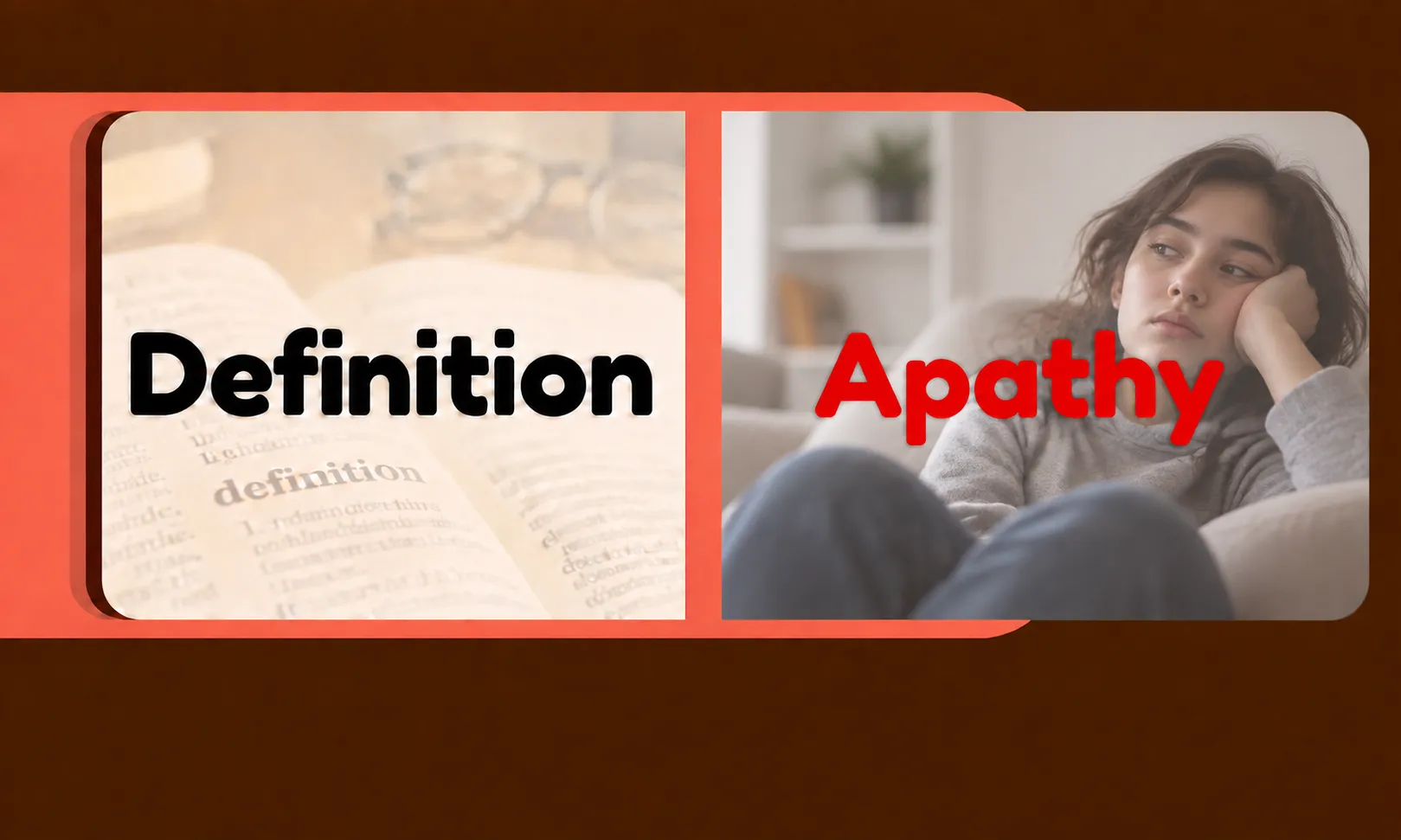
Apathy is a word people often hear when someone seems uninterested, emotionally distant, or unwilling to take action. The basic apathy definition refers to a lack of interest, concern, motivation, or emotional response toward something that would normally matter.
A person experiencing apathy may know that something is important but still feel little desire to respond.
People search for the meaning of apathy for many reasons. They may see the word in a book, social media post, news article, relationship discussion, or conversation about behavior.
Others may wonder whether being tired, bored, calm, or emotionally detached is the same as being apathetic.
The word can describe an attitude, a temporary feeling, or a pattern of behavior. However, its meaning can change slightly depending on the situation.
Understanding these differences helps prevent confusion and makes it easier to use the term correctly in everyday conversations.
Apathy Meaning & Definition
What Does Apathy Mean?
Apathy means showing little or no interest, enthusiasm, concern, or emotional involvement in something.
Someone who feels apathetic may say, “I just don’t care,” but apathy is sometimes more complicated than simply choosing not to care. A person might understand that a situation deserves attention while still feeling no strong motivation to react.
For example, imagine a student who usually enjoys school but suddenly stops caring about assignments, grades, clubs, or activities. The student may still attend classes but show very little interest in participating. That behavior might be described as apathetic.
Apathy can affect different areas of life, including:
- Work
- Education
- Relationships
- Hobbies
- Social activities
- Personal goals
- Everyday responsibilities
Simple Definition of Apathy
In simple words, apathy is a lack of interest, motivation, or emotional concern.
It does not always mean that a person has no emotions at all. Someone can feel emotions in certain situations while showing apathy toward others.
For example:
“He showed apathy toward the argument and did not choose either side.”
In this sentence, apathy suggests that he had little interest in becoming involved.
Background of Apathy
Where Does the Word Come From?
The word apathy has roots in ancient Greek. Its historical meaning was connected with being free from strong emotion or passion.
Over time, the English meaning developed into the idea of lacking interest, concern, feeling, or motivation.
Today, the word is commonly used in psychology, everyday speech, workplace discussions, relationships, education, and online conversations.
How the Meaning Changed
In some ancient philosophical traditions, emotional detachment could be viewed positively because it represented freedom from uncontrolled emotions. Modern everyday English usually uses apathy more negatively.
Today, calling someone apathetic often suggests that the person is not responding to something that might normally deserve attention.
For example:
“Public apathy toward the issue made it difficult to attract volunteers.”
Here, the word suggests that people were not interested enough to become involved.
However, context matters. A quiet person is not automatically apathetic, and choosing not to react dramatically does not necessarily mean someone lacks concern.
Usage of Apathy in Different Contexts
Everyday Conversations
In daily speech, apathy usually describes someone who appears uninterested or unmotivated.
For example:
“Her apathy toward the project surprised the whole team.”
This means she showed little interest or enthusiasm about the project.
Social Media
On social media, people sometimes use apathy when discussing emotional distance, social issues, relationships, school, work, or online behavior.
Someone might write:
“I’m feeling completely apathetic about social media lately.”
This usually means they have lost interest in posting, scrolling, commenting, or engaging with online content.
Professional Settings
In workplaces, employee apathy can describe a noticeable lack of enthusiasm or involvement.
An employee may complete only the minimum required work, stop sharing ideas, or appear uninterested in team goals.
However, managers should avoid labeling someone as apathetic without understanding the situation. Stress, exhaustion, unclear expectations, personal problems, or workplace conditions can sometimes create behavior that looks similar.
Apathy Meaning in Chat, WhatsApp, Instagram, and TikTok
Apathy in Text Messages
In texting, apathy usually keeps its standard meaning. It is not commonly used as a special abbreviation or secret slang term.
For example:
Person 1: “Do you still care about what happened?”
Person 2: “Honestly, I just feel apathy toward the whole situation now.”
Here, the person is saying they no longer feel strongly involved.
Apathy on WhatsApp
On WhatsApp, someone might use the word when explaining why they are not reacting emotionally.
For example:
“It’s not anger anymore. It’s more like apathy.”
This suggests the person has moved from a strong emotion to feeling emotionally uninterested or detached.
Apathy on Instagram
Instagram posts may use apathy in captions about motivation, relationships, social concerns, or personal growth.
For example:
“Trying to move from apathy back to curiosity.”
The meaning here is about recovering interest and engagement.
Apathy on TikTok
TikTok discussions may use the term when talking about motivation, dating, friendships, school, work, or internet culture.
Because short videos sometimes simplify complex ideas, viewers should remember that ordinary apathy and medical symptoms are not automatically the same thing.
Apathy in Physics, Medical, and Aircraft Terminology
Apathy in Physics
Apathy is not a standard technical term in physics.
Physics uses terms such as inertia, equilibrium, force, energy, momentum, and resistance, but these should not be confused with human apathy.
People may sometimes use apathy metaphorically when describing something as inactive or unresponsive, but that is figurative language rather than scientific terminology.
Apathy in Medical Contexts
In healthcare and clinical discussions, apathy can describe reduced motivation, initiative, interest, or emotional engagement.
The medical use can be more specific than the casual everyday meaning.
A person showing noticeable changes in motivation or behavior may require proper professional evaluation rather than simply being described as lazy or uncaring.
Apathy can sometimes appear alongside different physical, neurological, or psychological conditions, but the word itself is not a diagnosis that people should apply to themselves based only on an online definition.
Apathy in Aircraft Terminology
Apathy is also not a standard aircraft or aviation engineering term.
Aviation uses specialized terms for flight conditions, systems, crew performance, navigation, aircraft behavior, and safety procedures. Apathy may occasionally appear in discussions about human behavior, such as poor engagement or lack of attention, but it does not describe a specific aircraft component or flight condition.
Common Misconceptions About Apathy
Apathy Means Laziness
One common mistake is assuming apathy and laziness are identical.
They are not.
Laziness usually describes an unwillingness to make an effort. Apathy is more closely connected with a lack of interest, motivation, or concern.
Someone may want a good result but avoid doing the work because it feels difficult. That could be described as laziness.
Another person may genuinely feel little interest in the result at all. That is closer to apathy.
Apathy Means Someone Has No Feelings
Apathetic people do not necessarily lack every emotion.
A person might feel excitement about music but show no interest in school. Someone else may care about family but feel apathetic toward workplace goals.
Apathy can be selective.
Calmness Is the Same as Apathy
Calm people can care deeply.
A person who responds quietly during a disagreement may simply have good emotional control. Apathy means a lack of concern or engagement, not merely a lack of dramatic reaction.
Apathy Is Always Permanent
Apathy can be temporary.
Someone may temporarily lose interest because of stress, disappointment, exhaustion, frustration, or changing priorities.
Similar Terms & Alternatives
Several words have meanings that overlap with apathy, but they are not perfect replacements.
Indifference
Indifference means not having a strong preference or concern.
Example:
“She was indifferent about which restaurant they chose.”
This does not necessarily suggest a broad loss of motivation.
Disinterest
Disinterest commonly means a lack of interest.
“He showed little interest in the discussion.”
It is often simpler and less emotionally loaded than apathy.
Detachment
Detachment means being emotionally separated or less personally involved.
A person can intentionally remain detached while still caring about the outcome.
Unconcern
Unconcern describes an absence of worry or interest.
Depending on the context, it can sound neutral or negative.
Listlessness
Listlessness describes low energy or enthusiasm. Someone may seem listless while still caring deeply about what is happening.
How to Respond to Apathy
Avoid Immediate Judgment
If someone appears apathetic, calling them lazy, selfish, or uncaring may not help.
A better first step is to understand what has changed.
You might ask:
“You don’t seem as interested in this as before. Is something different?”
This gives the person an opportunity to explain.
Make Tasks More Manageable
Sometimes people lose motivation when something feels overwhelming.
Breaking a large responsibility into smaller tasks may make it easier to begin.
Instead of thinking:
“I need to finish everything today.”
Try:
“I will complete one small part first.”
Look for Patterns
It can help to notice whether the lack of interest affects one specific area or many parts of life.
Someone who has lost interest in one hobby may simply have developed new interests. A broader and persistent change may deserve more attention.
Seek Appropriate Support When Needed
If a significant loss of motivation or interest is persistent, unusual, or seriously affecting daily functioning, talking with an appropriate healthcare professional may be useful.
Online definitions can explain vocabulary, but they cannot determine the cause of an individual’s behavior.
Differences Between Apathy and Similar Words
Apathy vs Indifference
Apathy often suggests low motivation or emotional engagement.
Indifference usually means not caring strongly about one choice, issue, or outcome.
For example:
“I’m indifferent between tea and coffee.”
That simply means either option is acceptable.
Apathy vs Laziness
Laziness focuses more on effort.
Apathy focuses more on interest and motivation.
Someone can care greatly about a result while procrastinating because they do not want to work. That is different from not feeling motivated by the result itself.
Apathy vs Boredom
Boredom usually involves wanting something more interesting or stimulating.
An apathetic person may not strongly desire an alternative at all.
For example, a bored student may want to leave class and play a game. An apathetic student may show little interest in either activity.
Apathy vs Emotional Detachment
Emotional detachment can sometimes be intentional.
Professionals in stressful roles may maintain emotional distance so they can think clearly while still caring about their responsibilities.
Apathy more strongly suggests reduced concern, motivation, or interest.
Relevance of Apathy in Online Conversations & Dating Apps
Apathy in Online Communication
Digital communication makes emotions harder to interpret.
Short replies such as:
“Okay.”
“Whatever.”
“Doesn’t matter.”
may look apathetic, but they do not prove that someone feels apathy.
The person might be busy, tired, distracted, uncomfortable, or simply someone who prefers short messages.
Context is important before making assumptions.
Apathy in Dating Apps
On dating apps, apathy may describe someone who appears to have very little interest in maintaining a conversation.
Possible signs might include repeatedly giving minimal responses, never asking questions, or showing no enthusiasm about continuing the interaction.
However, these behaviors can have many explanations.
Someone may be busy, uncertain, shy, talking to several matches, or simply not interested in that particular conversation.
Instead of immediately labeling the behavior as apathy, it is usually clearer to focus on observable communication.
For example:
“I feel like I’m carrying most of the conversation. Are you still interested in chatting?”
That approach is more useful than guessing what the other person feels.
In online relationships, clear communication is often more reliable than interpreting one-word replies or delayed messages.
Conclusion
The apathy definition centers on a lack of interest, concern, motivation, or emotional engagement. It can describe someone’s attitude toward a specific subject or a broader pattern of reduced involvement.
In everyday conversations, the term is often used when a person appears uninterested or unwilling to participate, while professional and medical contexts may use it more carefully.
Apathy should not automatically be confused with laziness, boredom, calmness, indifference, or emotional detachment. These ideas can overlap, but each describes something slightly different.
The word is also common in texts, social media conversations, workplace discussions, relationships, and dating apps. However, short messages or quiet behavior alone cannot prove that someone is apathetic.
Understanding the context makes the word much easier to use correctly. When apathy appears persistent and significantly affects everyday functioning, appropriate professional guidance may be more helpful than relying on labels or assumptions.