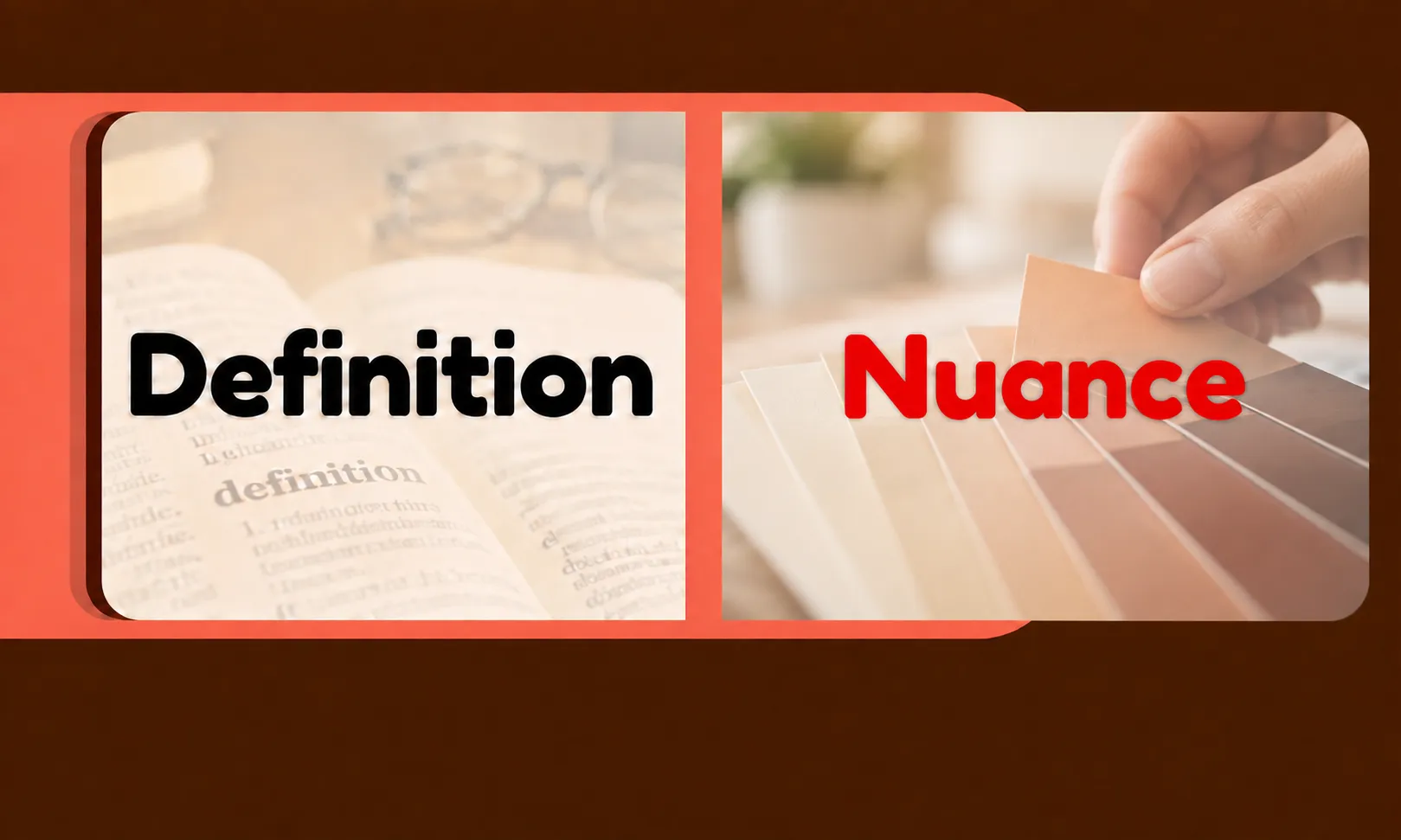
The word nuance is often used when something has a small but meaningful difference that may not be obvious at first. You might hear someone talk about the nuance of a conversation, the nuance in a person’s tone, or the subtle nuances of a complicated situation. In each case, the word points to a fine detail that changes how something should be understood.
People often search for the nuance definition because the term appears in social media discussions, relationships, literature, professional communication, politics, art, and everyday conversations.
Although the basic meaning is simple, understanding how nuance works can help you communicate more clearly and avoid misunderstandings.
Nuance is especially important when a situation cannot be explained as completely right or wrong, positive or negative, or simple or complicated.
This guide explains its meaning, background, common uses, related words, online relevance, and practical examples in clear and easy language.
Meaning & Definition of Nuance
What Does Nuance Mean?
Nuance means a small or subtle difference in meaning, feeling, expression, tone, or appearance. It describes a detail that may seem minor but can influence how something is understood.
For example:
- Her smile had a nuance of sadness.
- The debate requires a more nuanced understanding.
- His tone contained subtle nuances of disappointment.
In these examples, the differences are not dramatic. They are small details that provide additional meaning.
Imagine two people saying, “That was interesting.”
One person may say it enthusiastically because they truly enjoyed something. Another may say the exact same words sarcastically because they disliked it.
The words are identical, but the tone creates a nuance that changes the meaning.
Simple Meaning
In simple words, nuance means:
A small detail or difference that adds extra meaning.
Nuance can appear in:
- Speech
- Facial expressions
- Writing
- Emotions
- Colors
- Opinions
- Relationships
- Art
- Music
Understanding these subtle details often helps people understand the bigger picture more accurately.
Background of the Word Nuance
The concept of nuance has existed for centuries because humans naturally notice small differences in communication, emotions, colors, and behavior.
The term developed from language connected with the idea of subtle shading. This makes sense because shades of color provide a useful example of nuance.
Consider the color blue.
There is navy blue, sky blue, royal blue, baby blue, and many other shades. All are blue, but each has a slightly different appearance.
Language works in a similar way.
Two words may have almost the same dictionary meaning while creating different emotions or impressions.
For example:
Confident
This usually suggests that someone believes in their abilities.
Arrogant
This suggests excessive confidence or an exaggerated sense of importance.
Both words can describe a person who strongly believes in themselves, but the emotional meaning is different.
That difference is a nuance.
Today, the word is commonly used when discussing communication, literature, psychology, workplace conversations, relationships, entertainment, and complicated social topics.
Usage of Nuance in Different Contexts
Nuance can appear almost anywhere because communication and interpretation often depend on small details.
Everyday Conversation
In ordinary speech, nuance often refers to tone, expression, or intention.
Someone might say:
“There was a nuance of irritation in his voice.”
This means the person did not openly sound angry, but there was a small hint of irritation.
Writing and Literature
Writers use nuance to make characters, emotions, and situations feel more realistic.
Instead of describing a character as simply happy or sad, an author may show several emotions at once.
A person might feel proud about getting a new job while also feeling nervous about leaving their old coworkers.
That emotional complexity creates nuance.
Professional Communication
Nuance matters greatly at work.
A short email such as:
“Please send this again.”
may sound neutral to one person but impatient to another.
Changing it to:
“Could you please send the document again when you have a moment?”
creates a softer tone.
Small wording changes can completely influence how professional messages are interpreted.
Nuance Meaning in Chat, WhatsApp, Instagram, and TikTok
Online conversations depend heavily on nuance because people cannot always see facial expressions or hear tone of voice.
Nuance in Chat
In texting, punctuation can create subtle differences.
Compare:
“Okay.”
“Okay!”
“Okay 😂”
“Okay…”
All contain the same basic word, but each can communicate something different.
“Okay!” may sound enthusiastic.
“Okay…” can suggest hesitation, disappointment, suspicion, or uncertainty.
That is nuance in digital communication.
On WhatsApp, nuances may come from:
- Reply speed
- Emojis
- Voice notes
- Punctuation
- Short responses
- GIFs
- Message reactions
For example, receiving “fine” may feel different from receiving “Fine 😊.”
Instagram and TikTok
On Instagram and TikTok, people commonly discuss the “nuance” of opinions.
Someone may comment:
“This situation needs more nuance.”
Usually, they mean that the discussion is oversimplifying something complicated.
They want people to consider additional details, circumstances, or perspectives instead of making a quick conclusion.
Nuance in Physics, Medical, and Aircraft Terminology
Nuance is primarily a general-language word rather than a standard technical measurement in physics, medicine, or aviation. However, the concept of subtle differences can still be relevant in these fields.
Physics
In physics, tiny differences in measurements, conditions, or variables can sometimes produce meaningful changes.
A scientist might informally talk about the nuances of an experiment when referring to small details that influence results.
However, nuance itself is not normally a specific scientific unit or physical measurement.
Medical Context
Medical professionals may use the word in ordinary professional language.
For example:
“There are important nuances in diagnosing this condition.”
Here, nuance means that diagnosis may involve subtle differences between symptoms, patient histories, test results, or other factors.
It does not refer to a particular disease or medical procedure.
Aircraft and Aviation
In aviation, nuance may describe subtle differences between aircraft behavior, operating procedures, controls, or flying techniques.
A pilot might discuss the nuances of handling different aircraft.
Again, the term describes fine details rather than a specific aviation component.
Common Misconceptions About Nuance
One common misunderstanding is that nuance simply means “difference.”
A difference can be very large.
For example:
“A bicycle is different from an airplane.”
That is clearly a difference, but it would rarely be described as a nuance.
Nuance generally involves a small, subtle, or delicate difference.
Another misconception is that nuance makes an issue unnecessarily complicated.
In reality, recognizing nuance often makes an explanation more accurate.
Imagine someone saying:
“He did not answer my message because he is rude.”
There could be many other explanations.
Perhaps he was working.
Maybe his phone battery died.
Maybe he saw the message and forgot to respond.
A nuanced interpretation considers these possibilities before reaching a conclusion.
Another mistake is assuming that nuance means avoiding a clear opinion. You can have a strong opinion while still recognizing that situations may contain exceptions, complications, and additional perspectives.
Similar Terms & Alternatives to Nuance
Several words are related to nuance, although they do not always mean exactly the same thing.
Subtlety
A subtlety is a small detail that may be difficult to notice.
Example:
“She noticed a subtlety in his expression.”
Distinction
A distinction is a difference between two things.
It can be subtle or obvious.
Example:
“There is an important distinction between confidence and arrogance.”
Shade
Shade can describe a slight variation in color, meaning, or opinion.
Example:
“There were different shades of meaning in his statement.”
Undertone
An undertone is a feeling, meaning, or quality that exists beneath the obvious message.
Example:
“His comment had an undertone of frustration.”
Detail
Detail is broader than nuance. Every nuance can be considered a detail, but not every detail is necessarily subtle enough to be called a nuance.
How to Respond When Someone Mentions Nuance
When someone says, “There is more nuance to this,” they are usually suggesting that additional details should be considered.
A useful response could be:
Ask for Clarification
You might say:
“What details do you think are being missed?”
This encourages the person to explain their perspective.
Consider Multiple Factors
Instead of immediately defending your original opinion, consider whether circumstances could change the interpretation.
For example:
Person A: “He ignored my message.”
Person B: “There may be some nuance there. Maybe he was busy.”
A thoughtful response would be:
“That is possible. I should probably find out before assuming why he didn’t answer.”
Recognizing nuance does not mean accepting every possible explanation. It simply means considering relevant details before reaching a firm conclusion.
Differences Between Nuance and Similar Words
Understanding related terms becomes easier when their differences are clear.
Nuance vs Difference
A difference can be large or small.
A nuance is normally subtle.
For example:
A car and a bicycle have obvious differences.
Two slightly different shades of red have nuances.
Nuance vs Detail
A detail is any individual piece of information.
A nuance is usually a detail that changes interpretation or meaning in a subtle way.
Nuance vs Context
Context refers to the circumstances surrounding something.
Nuance refers to subtle differences within those circumstances.
For example, understanding the context of an argument may help you notice nuances in what each person meant.
Nuance vs Subtlety
These terms are closely related.
Subtlety emphasizes something being difficult to notice.
Nuance emphasizes a slight variation in meaning, tone, feeling, or appearance.
The words can sometimes be used similarly, but their emphasis is slightly different.
Relevance of Nuance in Online Conversations & Dating Apps
Nuance has become particularly important in digital communication because written messages remove many signals available in face-to-face conversations.
You cannot always hear someone’s voice, see their facial expression, or observe their body language.
This creates opportunities for misunderstanding.
Online Conversations
Consider the message:
“Sure.”
Depending on context, it could mean:
- Yes, happily.
- Yes, reluctantly.
- I don’t really care.
- I am annoyed.
- I agree.
The surrounding conversation provides the nuance needed to understand the intended meaning.
Emojis can also change interpretation.
“Sure 🙂”
may feel friendly.
“Sure 🙄”
can communicate annoyance or sarcasm.
Dating Apps
Nuance is particularly relevant on dating apps because people are trying to understand personality, interest, humor, and intentions through relatively short messages.
A message like:
“We should hang out sometime.”
might express genuine interest, casual friendliness, or politeness.
The next messages, response timing, conversation style, and level of engagement may provide more context.
However, subtle clues should not automatically be treated as definite proof of someone’s intentions. When something important is unclear, direct communication is usually more reliable than analyzing every tiny detail.
Understanding nuance can make online communication more thoughtful while preventing people from jumping too quickly to conclusions.
Why Nuance Matters in Communication
Nuance helps people communicate with greater accuracy.
Without nuance, conversations can become overly simplified.
For example, a person might describe a movie as “bad,” but their full opinion could actually be:
“The acting was excellent, but the story moved too slowly for me.”
The second explanation contains more nuance.
It tells us that the person did not dislike everything about the film.
Nuance is also valuable during disagreements.
Two people may appear to have completely opposite opinions, but after discussing the details, they may discover that they actually agree on several points.
Recognizing subtle differences can help reduce unnecessary arguments.
It is particularly valuable when discussing emotions because people rarely feel only one emotion at a time.
Someone can be:
- Excited but nervous
- Happy but tired
- Proud but disappointed
- Grateful but uncertain
Nuance gives language enough flexibility to describe those complicated feelings more accurately.
Examples of Nuance in Sentences
Seeing the word in natural sentences can make its meaning easier to remember.
Everyday Examples
- She understood the nuance in his quiet response.
- The comedian’s joke contained several cultural nuances.
- You need to understand the nuance of the conversation before judging it.
- His performance captured every emotional nuance of the character.
- There is an important nuance between being honest and being unnecessarily harsh.
- The photograph captures subtle nuances of light and shadow.
- Her writing contains emotional nuances that make the characters believable.
- The issue is complicated and deserves a more nuanced discussion.
- Small nuances in tone can completely change how a text message feels.
- He understood the nuances of working with different personalities.
In each example, the word points toward something subtle that affects the overall meaning or experience.
Conclusion
Understanding the nuance definition helps you recognize small but meaningful differences in language, emotions, opinions, behavior, and communication. A nuance is not simply any difference.
It is usually a subtle variation that adds another layer of meaning.
These fine distinctions appear everywhere. Tone can add nuance to spoken words, emojis can add nuance to text messages, and personal circumstances can add nuance to complicated situations.
The concept is also useful in professional discussions, literature, social media, dating apps, and everyday communication.
Learning to notice nuance can help you avoid overly simple conclusions. Instead of immediately assuming what someone means, you can consider tone, context, intention, circumstances, and other important details.
The next time someone says that a topic “needs more nuance,” they are usually asking for a deeper and more complete understanding rather than a simple black-and-white explanation.