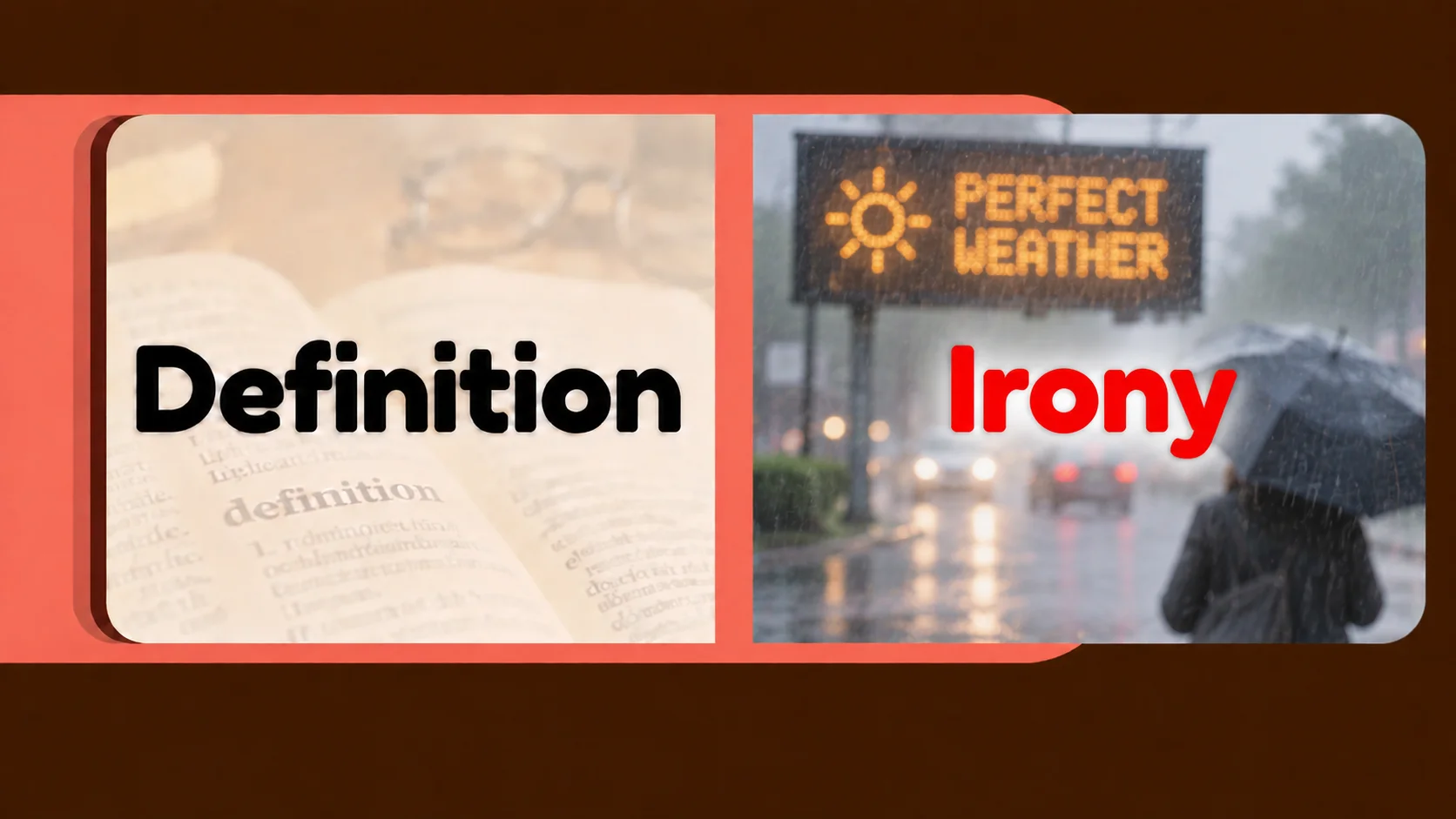
Irony is a common part of everyday language, humor, stories, social media, and casual conversations. It happens when the real meaning of a situation or statement is different from what appears on the surface.
Sometimes a person says the opposite of what they truly mean. In other cases, an event produces a result that is very different from what people expected.
People often search for the irony definition because irony can be confused with sarcasm, coincidence, satire, or simple bad luck. Understanding the term makes jokes, books, movies, online posts, and everyday conversations much easier to understand.
Irony can be funny, serious, awkward, or even sad. Context usually decides its meaning. Once you understand the basic idea behind irony, spotting it in daily life becomes much easier.
Meaning & Definition
Irony means a contrast between what is expected, said, or believed and what actually happens or is truly meant.
A simple example is a person looking outside during heavy rain and saying, “What beautiful weather.” The words sound positive, but the speaker actually means the weather is unpleasant.
Irony can appear in several forms.
Verbal Irony
Verbal irony happens when someone says something but intends a different or opposite meaning.
For example, after dropping a plate of food on the floor, someone might say, “Well, that went perfectly.”
Situational Irony
Situational irony happens when the final result is very different from what people naturally expect.
For example, imagine a professional driving instructor receiving a parking ticket. The unexpected contrast creates irony.
Dramatic Irony
Dramatic irony is common in movies, plays, and books. It happens when the audience knows something that a character does not know.
This creates suspense, humor, or tension because viewers understand more about the situation than the person inside the story.
Background
The idea of irony has existed for centuries and has long been important in literature, drama, comedy, and everyday speech.
Writers use irony because it allows them to communicate more than the literal meaning of their words. A simple sentence can carry humor, criticism, disappointment, or surprise depending on its context.
Irony in Literature
Authors often use irony to make stories more interesting. A character may believe that everything is going well while the reader already knows that trouble is coming.
Situational irony can also create memorable endings. A person may spend an entire story trying to avoid one result, only to cause that exact result through their own actions.
Irony in Modern Language
Today, irony is not limited to books and plays. It appears constantly in memes, videos, comments, captions, group chats, and conversations.
Internet culture has made ironic humor especially popular. People may deliberately exaggerate opinions or pretend to support something ridiculous simply for comedic effect.
Usage in Different Contexts
The meaning of irony remains similar across different situations, but the way people use it can change.
Everyday Conversations
In normal conversation, irony often appears as playful humor.
Someone arriving five minutes after missing a bus might say, “Perfect timing.”
The statement is humorous because the timing was clearly not perfect.
Social Media
On social platforms, people frequently use ironic captions, memes, reactions, and comments.
For example, someone might post a picture of a completely messy desk with the caption, “My life is extremely organized.”
Readers understand that the statement is intentionally opposite to reality.
Professional Fields
Irony may also appear in journalism, advertising, public speaking, teaching, literature, film, and marketing.
However, professional communication usually requires more caution. Irony depends heavily on tone and context, so it can easily be misunderstood in formal messages.
Meaning in Chat, WhatsApp, Instagram, and TikTok
Online communication has made irony even more common.
In chats, people often use ironic comments to make conversations funnier or less serious.
Irony in Chat and WhatsApp
Imagine someone sends a message saying:
“I studied for ten minutes. Clearly, I deserve the highest grade.”
The person probably does not genuinely believe ten minutes of study guarantees excellent marks. The exaggeration creates an ironic joke.
Irony on Instagram
Instagram users often combine irony with photos and captions.
A picture showing someone soaked by rain might include the caption:
“Best day to forget my umbrella.”
The contrast between the positive wording and unpleasant situation creates humor.
Irony on TikTok
TikTok humor often uses deliberate exaggeration, unexpected reactions, or statements that should not be interpreted literally.
Tone, facial expressions, captions, emojis, and video context help viewers recognize when the creator is being ironic.
Meaning in Physics, Medical, and Aircraft Terminology
Irony is mainly a language, literary, and communication term. It does not normally have a separate technical definition in physics, medicine, or aviation.
In Physics
Physics uses specialized terms for forces, energy, motion, matter, and physical systems. “Irony” is not normally a scientific measurement, law, or physical process.
If the word appears in physics-related writing, it is usually being used in its normal language sense.
For example, someone might describe it as ironic that a machine designed to save energy uses excessive electricity.
In Medical Contexts
Irony is not a standard medical diagnosis or treatment term.
A healthcare professional or writer may use the ordinary word to describe an unexpected contrast, but that does not give irony a special medical definition.
In Aircraft and Aviation
Irony is also not normally a technical aircraft term. It may appear in conversations, aviation stories, reports, or jokes, but its ordinary English meaning remains the same.
Common Misconceptions
One of the biggest problems with irony is that people often use the word for situations that are merely unfortunate, strange, or coincidental.
Irony Is Not Always Coincidence
A coincidence happens when two events unexpectedly occur together.
Suppose you meet an old friend at an airport in another country. That may be surprising, but it is mainly a coincidence.
Irony usually requires some meaningful contrast between expectation and reality.
Irony Is Not Always Sarcasm
Sarcasm and irony can overlap, but they are not identical.
Sarcasm is often directed at a person or situation and may contain mockery.
If someone makes an obvious mistake and another person says, “Brilliant work,” that could be sarcastic as well as verbally ironic.
However, irony does not always attack or mock anyone.
Irony Is Not Simply Bad Luck
Missing a train is unfortunate.
Missing a train because you stopped to give someone advice about always arriving early creates a stronger ironic contrast.
Similar Terms & Alternatives
Several words are related to irony, although they should not always be used as exact replacements.
Sarcasm
Sarcasm often uses words that mean the opposite of what the speaker really thinks, usually to tease, criticize, or mock.
Satire
Satire uses humor, exaggeration, or irony to criticize behavior, ideas, institutions, or social problems.
It is often found in comedy, writing, television, and cartoons.
Paradox
A paradox is a statement or situation that appears contradictory but may contain an underlying truth.
It is different from irony, although both can involve surprising contrasts.
Coincidence
Coincidence describes unexpected events occurring together without necessarily involving a contrast between expectation and reality.
Other related ideas include contradiction, unexpected twist, dry humor, understatement, and comic contrast.
How to Respond to Irony
The best response depends on the situation and the speaker’s intention.
When Irony Is Playful
If someone is clearly joking, you can respond with humor.
For example:
Person: “Lovely weather,” while standing in pouring rain.
Response: “Perfect for a picnic.”
Playing along shows that you understood the joke.
When You Are Unsure
Online messages can make irony difficult to detect because you cannot always hear the speaker’s tone.
You can simply ask:
“Are you being serious or ironic?”
This is especially useful when the topic is important.
When Irony Feels Offensive
Not all ironic humor is harmless. If a statement feels insulting or confusing, respond to its actual effect rather than trying to guess the speaker’s intention.
Clear communication usually works better than continuing a joke that one person does not enjoy.
Differences From Similar Words
Irony becomes easier to understand when compared directly with related terms.
Irony vs Sarcasm
Irony involves a contrast between appearance and reality, words and meaning, or expectation and outcome.
Sarcasm often uses that contrast specifically for criticism or mockery.
Irony vs Satire
Irony is a technique.
Satire is a broader style of humor or criticism that may use irony as one of its tools.
Irony vs Coincidence
Coincidence involves unexpectedly connected events.
Irony requires a meaningful contrast.
Finding that your friend bought the same shoes as you is coincidence. A shoe shop owner forgetting to wear shoes to work could be considered ironic.
Irony vs Paradox
A paradox appears logically contradictory.
Irony focuses more strongly on the difference between what appears likely or true and what actually happens or is intended.
Relevance in Online Conversations & Dating Apps
Irony plays a major role in modern digital communication.
People use it to show personality, create jokes, flirt, reduce awkwardness, or make ordinary conversations more entertaining.
Irony in Online Conversations
Messages such as “I absolutely love Monday mornings” may be ironic when the surrounding conversation shows that the person dislikes waking up early.
Memes also depend heavily on this kind of humor.
The challenge is that written text lacks facial expressions and vocal tone. Because of this, an ironic comment may sometimes look serious.
Irony on Dating Apps
People may use ironic humor in dating profiles to sound playful.
A profile might say:
“Professional chef. I make excellent cereal.”
The contrast creates a light joke while also revealing something about the person’s humor.
Irony can help start conversations, but excessive ironic language may create confusion. When discussing feelings, intentions, boundaries, or plans, direct language is usually clearer.
Frequently Asked Questions
What is a simple definition of irony?
Irony is a contrast between what someone expects, says, or believes and what actually happens or is truly meant.
What is an easy example of irony?
If someone walks into heavy rain and says, “What amazing weather,” the comment is ironic because the intended meaning is opposite to the literal words.
What are the main types of irony?
The three commonly discussed types are verbal irony, situational irony, and dramatic irony.
Is irony the same as sarcasm?
No. Sarcasm often uses ironic wording, but it usually includes mockery or criticism. Irony can exist without insulting anyone.
What is situational irony?
Situational irony happens when an event produces an outcome that strongly contrasts with what people reasonably expected.
Why do people use irony online?
People use irony to create humor, express frustration, exaggerate situations, make memes, or communicate ideas indirectly.
How can you tell if someone is being ironic?
Look at the context, tone, emojis, exaggeration, facial expressions, and whether the literal statement clearly conflicts with reality.
Conclusion
Irony is an important communication technique built around contrast. It can appear when people say something different from what they truly mean, when events end in unexpected ways, or when an audience understands information that a character does not.
Learning the irony definition also makes it easier to distinguish irony from sarcasm, satire, coincidence, and paradox. These terms may overlap, but they describe different ideas.
Irony appears everywhere, from literature and movies to WhatsApp conversations, Instagram captions, TikTok videos, memes, and dating profiles. It can make communication clever, humorous, dramatic, or memorable.
The most important part of understanding irony is context. Words alone may not reveal the speaker’s real intention. By paying attention to the situation, tone, expectations, and actual outcome, you can recognize irony more accurately and understand why it remains such a powerful part of everyday language.

Alex Chuckles is a comedy writer and humor enthusiast who loves creating funny and entertaining content for readers worldwide. He is passionate about spreading laughter and making people smile through creative jokes and lighthearted stories.