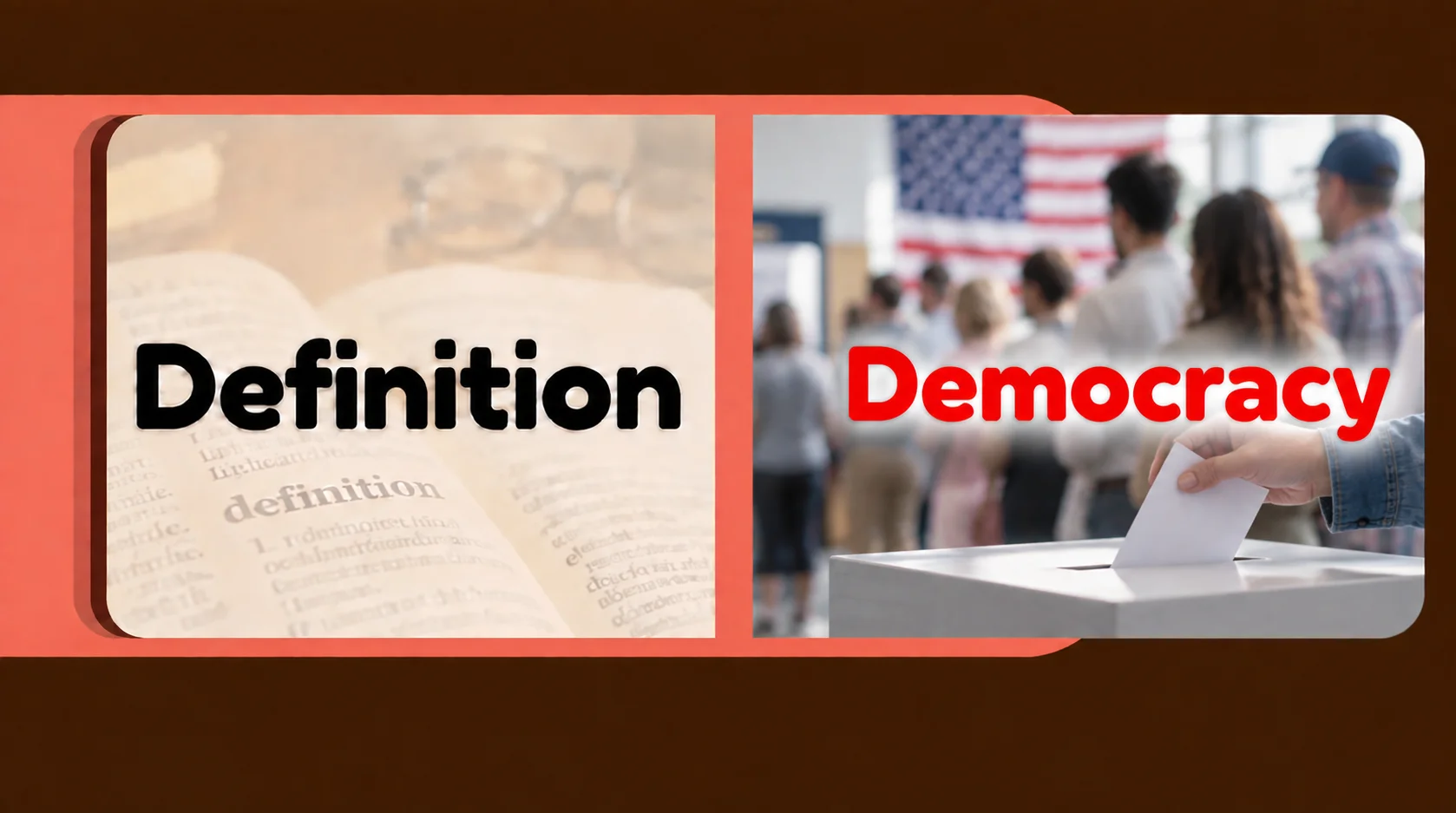
Democracy is one of the most widely discussed ideas in politics, government, education, media, and everyday conversation.
People often search for a clear democracy definition because the word appears in news reports, school lessons, social media debates, elections, and discussions about rights and government.
At its simplest, democracy is a system in which political authority is connected to the people. Citizens usually participate by voting, choosing representatives, expressing opinions, and taking part in public life.
However, democracy can take different forms depending on a country’s laws, institutions, and political system.
The word can also describe values such as participation, representation, equality before the law, accountability, and public involvement in decision-making.
Understanding democracy is useful because it helps people make sense of elections, political institutions, public debates, rights, laws, and civic responsibilities.
This guide explains its meaning, background, common uses, misconceptions, related terms, and role in modern online conversations.
Meaning & Definition
What Does Democracy Mean?
Democracy is a form of government in which political power ultimately comes from the people. Citizens may exercise that power directly or choose representatives who make decisions on their behalf.
In many modern democracies, citizens vote in elections to select lawmakers, leaders, or other public officials. Elections are therefore an important part of democracy, but democracy involves more than voting alone.
Democratic systems commonly include institutions and principles connected with political participation, legal protections, accountability, representation, and rules governing how public power is exercised.
The exact structure varies from one country to another.
Simple Democracy Definition
A simple definition is:
Democracy is a system of government in which people have a role in choosing leaders and influencing public decisions.
The word may also describe a broader political principle in which citizens are considered participants in public life rather than merely subjects of government authority.
Democracy as a Political Idea
Democracy is both a system and an ideal.
As a system, it describes institutions such as elections, legislatures, constitutions, courts, and political representation.
As an ideal, it can refer to ideas such as public participation, political equality, accountability, debate, and consent of the governed.
Because countries organize these features differently, not every democratic system looks exactly the same.
Background
Where Did the Word Democracy Come From?
The term “democracy” comes from ancient Greek roots. It combines ideas associated with “the people” and “rule” or “power.”
Ancient Athens is commonly discussed in the history of democracy because some citizens participated directly in political decision-making.
However, ancient democratic participation was very different from modern democratic citizenship. Political participation was limited, and many people living in society did not have the political rights that modern readers may associate with democracy.
Development of Modern Democracy
Modern democratic systems developed gradually over centuries.
Political thinkers, social movements, constitutional changes, legal reforms, and struggles over voting rights contributed to the development of modern representative government.
Over time, many political systems expanded participation and developed institutions designed to place limits on government authority.
Modern democracy is therefore not based on a single historical event. It developed through many different political traditions and experiences.
Representative Government
Because modern countries often contain millions of citizens, most democratic systems rely heavily on representation.
Citizens elect representatives who debate laws, approve policies, oversee government institutions, and make decisions within constitutional or legal limits.
This is usually called representative democracy.
Usage in Different Contexts
Democracy in Political Conversations
The word is most commonly used when discussing government and politics.
For example:
- “The country uses a democratic electoral system.”
- “Citizens discussed the importance of democracy.”
- “The class studied different forms of democratic government.”
In these examples, democracy refers to political participation and government.
Democracy in Social Discussions
People sometimes use the word more broadly to describe shared decision-making.
Someone might jokingly say:
“Let’s use democracy and vote on where to eat.”
Here, democracy does not refer to a national government. It simply means allowing members of a group to participate in a decision.
Democracy in Professional Environments
In workplaces, schools, organizations, and clubs, words such as “democratic” may describe a leadership style that invites participation.
A manager might ask team members for suggestions before making a decision.
This does not automatically make the workplace a political democracy. The word is being used metaphorically to describe collaborative or participatory decision-making.
Meaning in Chat, WhatsApp, Instagram, and TikTok
Democracy in Text Messages
In chats, the word usually keeps its normal political meaning.
For example:
Person A: “Why is everyone voting on the movie?”
Person B: “Democracy 😂”
Here, “democracy” is used humorously because everyone gets a vote.
Democracy on WhatsApp
WhatsApp groups may use the term when members vote on plans, dates, activities, or group decisions.
For example:
“Three people want Saturday and five want Sunday. Democracy wins.”
This is an informal use rather than a formal political definition.
Democracy on Instagram
On Instagram, the word may appear in educational posts, political discussions, news commentary, quotations, memes, or civic awareness content.
Its meaning depends heavily on context.
A serious post may discuss democratic institutions, while a meme may use the word jokingly to describe a group vote.
Democracy on TikTok
TikTok creators may discuss democracy in videos about history, government, elections, political science, current affairs, or civic education.
The term can also appear in humorous videos where people vote on everyday decisions.
Because social-media posts can simplify complicated political subjects, readers should pay attention to context before assuming what a creator means.
Meaning in Physics, Medical, and Aircraft Terminology
Democracy in Physics
Democracy is not a standard scientific term in physics.
A physicist would normally use the word only in its ordinary political or metaphorical meaning.
For example, someone might casually describe several competing scientific ideas as receiving “equal consideration,” but calling this “democracy” would be figurative language rather than formal physics terminology.
Democracy in Medical Contexts
Democracy is also not a standard medical diagnosis, treatment, or anatomical term.
However, discussions about healthcare policy may involve democratic ideas.
For example, public debate may concern healthcare funding, medical regulations, access to treatment, or government health policy.
In those cases, democracy refers to political decision-making rather than medicine itself.
Democracy in Aircraft Terminology
Democracy is not normally a technical aviation term either.
Pilots, engineers, manufacturers, and air-traffic professionals use specialized aviation terminology, but “democracy” does not describe a standard aircraft component or flight procedure.
It may still appear in discussions about aviation policy, government regulation, public administration, or metaphorical teamwork.
Common Misconceptions
Democracy Means Everyone Agrees
One common misunderstanding is that democracy requires everyone to agree.
It does not.
Democratic societies often contain major disagreements. Citizens may disagree about laws, leaders, public spending, taxation, education, foreign policy, and social issues.
Democracy provides mechanisms for handling disagreement through institutions, elections, laws, debate, and political participation.
Democracy Means Only Voting
Voting is important, but democracy is usually discussed more broadly.
Political participation may also include peaceful public debate, joining civic organizations, contacting representatives, running for office, following public affairs, participating in campaigns, or expressing political opinions within the law.
Majority Rule Is the Entire Definition
Majority decision-making is often associated with democracy, but democratic systems may also contain constitutional protections, legal limits, institutional checks, and protections for individual or minority rights.
For this reason, democracy is more complicated than simply saying, “whatever the majority wants happens.”
Similar Terms & Alternatives
Republic
A republic is a political system in which the state is not governed as a hereditary monarchy and public authority is typically exercised through institutions established by law.
“Republic” and “democracy” are not exact opposites.
A country can be both a republic and a democracy depending on its institutions.
Representative Government
Representative government means citizens choose people to make public decisions on their behalf.
This is a central feature of many modern democratic systems.
Constitutional Government
Constitutional government refers to political authority being organized and limited through constitutional rules.
A democracy may also be constitutional, meaning elected institutions operate within legal limits.
Self-Government
Self-government is a broader idea referring to people having authority over their own political affairs.
It is closely related to democratic thinking but is not always used as an exact synonym.
How to Respond to It
In an Educational Discussion
If someone asks, “What does democracy mean?” a clear response could be:
“Democracy is a system in which people participate in government, usually by voting for representatives or making political decisions.”
This gives the basic idea without making the explanation overly complicated.
During an Online Debate
Political conversations can quickly become emotional.
Instead of immediately arguing over labels, it can help to ask:
“What part of democracy are you referring to—elections, representation, rights, institutions, or public participation?”
This makes the conversation more precise.
In Casual Conversation
If someone jokingly says, “Let’s settle this with democracy,” they usually mean:
“Let’s vote.”
The correct response depends on whether the conversation is serious, educational, political, or humorous.
Differences From Similar Words
Democracy vs Republic
Democracy focuses on the role of the people in political authority and decision-making.
Republic generally describes a form of state in which public institutions operate without a hereditary monarch as head of the political order.
The concepts can overlap.
Democracy vs Monarchy
A monarchy has a monarch, such as a king or queen, as head of state.
However, monarchy and democracy are not always complete opposites.
Some countries have constitutional monarchies alongside elected governments and democratic institutions.
Democracy vs Dictatorship
A dictatorship concentrates political power in a leader or limited ruling group with substantially restricted public political control.
Democratic systems, by contrast, are based on mechanisms allowing citizens to participate in selecting political leadership and public decision-making.
Democracy vs Direct Democracy
Direct democracy allows citizens to vote directly on particular political decisions.
Representative democracy normally involves citizens electing officials who then make many decisions on their behalf.
Some political systems use elements of both.
Relevance in Online Conversations & Dating Apps
Democracy in Modern Online Discussions
Democracy appears frequently in online discussions because politics, elections, laws, rights, government policies, and social issues are widely discussed on digital platforms.
People may use the term seriously, sarcastically, humorously, or rhetorically.
Because the word carries strong political meaning, reading the full context is important.
Two people can use “democracy” while referring to different things. One may mean elections, while another may be discussing legal protections or political participation.
Democracy on Dating Apps
The word is less common in dating conversations, but it can still appear in profiles or messages.
Someone might mention democracy when describing political interests or personal values.
It can also appear humorously:
“You pick dinner tonight. I believe in democracy.”
On dating apps, political terms can reveal topics a person considers important, but a single word should not automatically be treated as a complete explanation of someone’s political beliefs.
Why Context Matters
Online language is often shortened, exaggerated, or turned into memes.
The safest way to understand what someone means by democracy is to consider the conversation around it rather than relying on the word alone.
Conclusion
Democracy is a political system and principle centered on the participation of people in public decision-making. In many modern systems, citizens choose representatives through elections, while laws and institutions establish how political authority can be exercised.
The meaning can change slightly depending on context. In government and political science, it refers to systems of political participation and representation.
In casual conversations, people may use “democracy” humorously when a group votes on something simple. It is not a standard technical term in physics, medicine, or aviation.
Understanding the democracy definition also requires distinguishing it from related ideas such as republic, representative government, constitutional government, and direct democracy.
Most importantly, democracy does not mean that everyone must agree. It provides structures through which people with different opinions can participate in political life, debate public questions, choose representatives, and influence government decisions according to established rules.

Alex Chuckles is a comedy writer and humor enthusiast who loves creating funny and entertaining content for readers worldwide. He is passionate about spreading laughter and making people smile through creative jokes and lighthearted stories.